Monday, June 27, 2016

Observations About Literary Contest Submissions

Copyright © 2016, Steven E. Houchin. All rights reserved.

I was selected again this year to evaluate manuscripts submitted by aspiring writers to a local literary contest. My task was to read the submitted pages and provide a critique and a score for a half-dozen aspects, such as Dialog, Plot, Synopsis, etc. Here are some observations about what I read.
  1. Following contest guidelines is half the battle. Of the five manuscripts I was assigned, three were disqualified! The most common mistake: the author's name was included. The manuscript is supposed to be anonymous. Hello! The next mistake: too many pages were submitted. If the guidelines say 25 pages max, don't submit 30 or 40. Another: placing page numbers at the bottom, when rules called for upper right corner. Bottom line, if you simply sumbit a clean manuscript that follows all the rules to the letter, you'll jump past half the other entrants right out of the gate.
  2. Know how to properly format a manuscript. An author who wishes to be taken seriously (let alone win a contest) ought to know standard manuscript formatting rules. One entry did not indent paragraphs, but did insert blank lines between them. Another did not understand the punctuation and formatting of dialog tags. These are basic things any aspiring author learns quickly simply by reading books or having their work critiqued by a local writers group.
  3. Write a compelling synopsis. A couple of the authors clearly did not understand the concept of a synopsis. One gave an introduction for a couple of main characters, and then launched into a glowing bio of himself and his remarkable talent. And, yes, exceeded the page limit. Another introduced the main character and her conflict well, but gave vague generalities about how the plot unfolded. Most of the authors just couldn't bring themselves to give away the story's ending, which is what contest judges and literary agents expect to see. I wrote a blog article some years back about synopses ( What's In a Synopsis?) that discusses some of what I have learned about them.
  4. Some writers don't understand viewpoint. This is common for newbie writers: they don't understand the concept that a scene is normally told inside the head of one particular character. I know, because I, too, got it all wrong when first starting out. The reader should only know, see, hear, smell, feel, and think through that character's brain and senses. A few contest authors' character viewpoint wandered all over, one becoming so omniscient the narrator expounded on what will happen in the future. A corollary to wandering viewpoint is the verb tense used by the narrator: one entrant mixed present tense with past tense.
  5. Overuse of backstory. Often, the author has a good grasp of the main character, but decides to tell the reader all about the character's life and history and miserable angst in the first couple of chapters. Unfortunately, the actual plot and storyline are trampled like a cat in a stampede. One entrant used so much backstory, it was difficult to figure out what was happening in the "Now."
  6. No scene setting. I'm a big fan of telling the reader "who" and "where" and "when" in the first paragraph or so of each scene. Where are we? Who is there? What time is it? Added to that, what does the character see, hear, etc? What does the room or street look and sound like? In most of the entries, setting the scene was done poorly. Often, the author supplied reams of narration about the character's pitiful life, or launched into unbroken dialog. For me, this gives the story a disembodied feel, as if the scene takes place in a wispy white netherworld.
I could go on about trivial dialog, lack of gestures or facial expressions by characters, and slow pace. But you get the picture. Don't get me wrong. A couple of the manuscripts I read were excellent, and might even end up a contest finalist. For the others, I hope my gentle critiques encourage them on to better things. Good luck to them all.


Monday, April 18, 2016

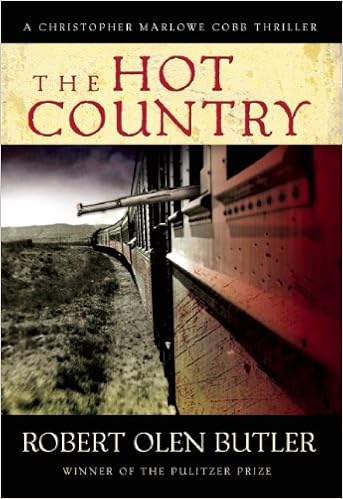
Book Review: The Hot Country

Copyright © 2016, Steven E. Houchin. All rights reserved.

This novel by Pulitzer Prize winning author Robert Olen Butler is the first in his series billed as "A Christopher Marlowe Cobb Thriller."

The story's setting is Vera Cruz, Mexico, in 1914 where Chicago reporter Christopher Marlowe "Kit" Cobb is assigned to report on the various rebel factions that are vying for power in an unstable Mexico, made more complex by America's invasion of the southern port city of Vera Cruz.

While there, Cobb meets a pretty Mexican woman, Luisa, who turns out to be a sniper for an unknown rebel group. Also in town is a German ship filled with armaments that also disgorges, in the dead of night, a mysterious German official who Cobb thinks may be trouble for the Americans. Following the German eventually leads to Panco Villa's rebel camp, but not before Cobb has to fight alongside some Villistas to save his own skin - thus earning Pancho Villa's respect. The German is there, too, to urge Villa to invade San Antionio, Texas, and possibly unite all Mexicans under arms for the fight. Cobb learns of this and must escape to tell the story.

The author does a great job immersing the reader in the place and time of 1914 Vera Cruz, peppering the story with the smells and tastes and emotions of the locality. Each chapter bubbles with tension and suspense and action. Cobb lives on the edge at times, taking chances more suited for a secret agent than a reporter, while he tries to determine the mystery German man's mission. And along the way, he hopes to reunite with the lovely Luisa, despite the fact she once held a gun to his head.

My only negative critique of the book is a writing device Butler uses that I find annoying and ineffective: he lapses into ultra-long sentences - some spanning a page or more - for the purpose, I assume, of creating a frantic sense of action or thoughts for the character. I often found myself just skimming over those sections, having gotten the gist in the first few lines. This is done repeatedly, and I think detracts a little from the overall excellence of the story.

All in all, The Hot Country is a great read that is hard to put down. The hardcover is about 325 pages.

Monday, February 15, 2016

Book Review: The Nomination

Copyright © 2016, Steven E. Houchin. All rights reserved.

This suspense novel by William G. Tapply employs a story technique I used in my first novel, Linear Descent, that I think of as the "character spiral." If you consider a spiral shape, such as a galaxy in space, it consists of numerous far-flung entities circling a center point, all drawn toward the center. At some point, they swirl inward and converge at that center, crashing together. In a character spiral, the entities are a cast of characters separated by distance, time, or unfamiliarity (i.e. strangers).

In The Nomination, the main characters are out at the edge of the spiral, living separated lives, with only tangential relationship. The center point, or the inciting incident in novelist terms, is the impending retirement of a Supreme Court justice. The president wants to appoint Massachusetts judge Thomas Larrigan, who is considered a Vietnam War hero with a squeaky-clean record. But Larrigan has a secret past: during the war, he abandoned a child bride and a gave away their baby for adoption. He connects with an old Marine pal, Eddie, who knows all about it. Eddie's old girlfriend knows, too, and Larrigan sends him down to Florida to take care of her.

In New York, that former child bride, Simone, is now a dying woman who agrees to let a ghostwriter tell her story. She'd had a brief acting career in the 1980s, becoming a cult celebrity before retiring due to her illness. She has the documents from her past, and a just-arrived package of photos sent to her by Eddie's girlfriend, who has been spooked by his sudden appearance in Florida.

Out in California, former police detective Jesse Church fears for her life after sending a mob boss to jail. After her picture appears in the paper, she goes on the run, but not before receiving a letter from Simone who believes Jesse to be her birth-daughter. So, Jesse heads for New York, thinking the mob hit-men won't find her there.

Writer Mac Cassidy gets the job to ghostwrite Simone's biography. He meets her and leaves behind a tape recorder that she'll use to dictate the story. She has no idea Thomas Larrigan is a judge and that he's been nominated for the high court. But, Eddie has found out about her from his long-ago girlfriend.

And so the characters spiral in toward one another, and the reader anticipates the impending crash that will happen when they meet. Mac has the tapes and photos, Eddie wants to silence Simone and get the photos (unaware of the book project), and Jesse wants to meet her mother and hide out, and the mob is on her trail. The reader has an inkling about what will happen, yet the outcome isn't exactly as expected. All in all, The Nomination is well worth the read. The hardcover is about 300 pages, so not too long.

Sunday, September 27, 2015

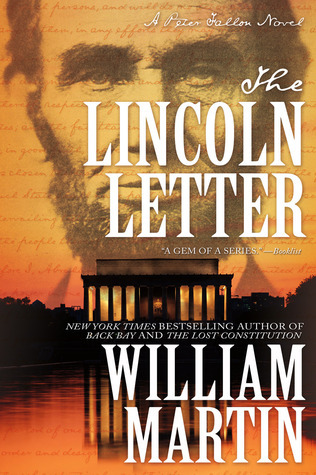
Book Review: The Lincoln Letter

Copyright © 2015, Steven E. Houchin. All rights reserved.

Everything about Abraham Lincoln continues to fascinate historians and inspire novelists. This seems to be the case for the historical suspense novel, The Lincoln Letter, author William Martin's fifth installment in the Peter Fallon series. A few years ago, I wrote a review of the second in this series, Harvard Yard, a book that I thoroughly enjoyed and which I think is his best story of the lot.


In The Lincoln Letter, antique hunter Peter Fallon and his on and off partner Evangeline Carrington are again drawn into an historical treasure hunt, spurred on by the discovery of a letter by Lincoln. Written on the day of his death to a Lieutenant Hutchinson, it states that the lieutenant possesses something that the president wants returned, something that had been missing for three years.

Peter, of course, is determined to find out what the missing something is, and travels to Washington D.C. to dig deeper into the mystery. But, others are also on the trail, people who have more sinister motives. Eventually, they all come to believe that the missing item is Lincoln's "day book", a diary where he has jotted down his thoughts on emancipation of the slaves.

As with his other books in the series, Martin jumps the reader back and forth in time, telling the story of Lieutenant Halsey Hutchinson and the day book; how he got hold of it, lost it, and strove to retrieve it again from 1862 through the end of the war and Lincoln's assassination. Along the way, Hutchinson witnesses historic events and is involved with infamous figures like Oliver Wendell Holmes, John Wilkes Booth, Walt Whitman, and the president himself.

In the present day, Peter and Evangeline face peril at the hands of the competition, who aren't afraid to use murder to get what they want. Of the Fallon novels, this may the the best after Harvard Yard, and is a couple of hundred pages shorter.

Sunday, July 12, 2015

Literary Agents and the Police

Copyright © 2015, Steven E. Houchin. All rights reserved.

Some writer friends told me about a panel of literary agents they'd heard at a local writer's conference. They moderated an open critique session, where the panel read snippets of attendees' work and offered their quick opinion. Some readings were the opening pages of novels, some were drafts of agent query letters, some were story ideas. The agents were reported to be rude, insulting, and dismissive of the authors' works, offering little in the way of constructive advice or encouragement. In other words, they acted like insensitive snobs bent on crushing the budding authors' dreams.

This all happened about the time of the Baltimore riots, where police were accused of causing the death of an arrested suspect due to negligence or worse. It all got me thinking about group behavior of those in power over others.

Our police have a difficult job, to say the least. Every day, they encounter many of the worst sorts in our society: drug dealers, violent gangs, thieves and burglars, rapists, wife beaters, murderers, liars and cheats. They face disrespect, resisting arrest, fleeing suspects, and numerous false cries of racism and brutality. Every day. On and on. They are human, and the daily dose of inhumanity and crime takes its toll until some, it seems, become jaded and insensitive to the people they encounter on the job. They may become gruff, short-tempered, and too quick to use force. And so the innocent may feel a bit roughed-up, leading to resentment and claims of brutality.

Enter the literary agents. A bit analogous to the police, they, too, are deluged each day with many of the worst sorts in the literary world: inane story ideas, amateurish query letters, sloppy chapter submissions, ignored submission rules, endless cat stories, authors making pitches over the bathroom urinals, and just plain bad writing. Day after day. On and on. So do they, too, become jaded and insensitive, expecting every new submission to be mindless crap? Do they have a knee-jerk reaction at writers' conferences that, of course, everything they hear is worthy of derision, no matter how much it hurts?

Just wondering.

Tuesday, June 23, 2015

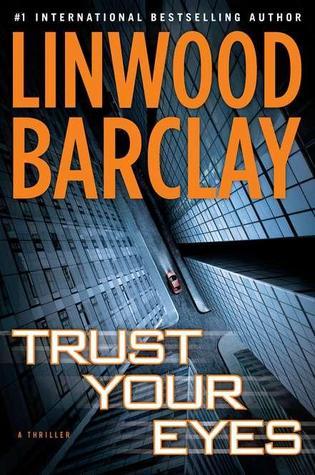
Book Review: Trust Your Eyes

Copyright © 2015, Steven E. Houchin. All rights reserved.

Author Lynwood Barclay's 2012 thriller Trust Your Eyes begins where any thriller or mystery should, with what we writers call "the inciting incident."  In this case, mildly schizophrenic Thomas Kilbride believes he sees a murder online.

Thomas is obsessed with maps. The walls of his room and the hallway outside are papered with them. He believes some cataclysm will wipe out all online maps, and he'll be the only one left with paper ones. He discovers a web site named Whirl360 (a thinly veiled reference to Google Street View) that allows him to "walk" streets around the world.  So, he spends all day in his room web-walking Whirl360's streets to memorize everything he sees, which he has the brilliance to do.

Trust Your Eyes image
One day, while web-walking a street in New York City, he looks up at an apartment building window and sees a person's head. A plastic bag is squeezed tightly over it.  A murder in progress, frozen in time by Whirl360's drive-by camera.  Thomas convinces his skeptical brother, Ray, to travel to New York City to investigate.  Ray discovers nothing unusual. The apartment is empty and he's told the girls who lived there have moved away.  He does nothing to dig deeper, but his arrival asking questions is noticed by the wrong people - those who ordered the murder.

The murder is orchestrated by Howard Talliman, the campaign strategist of an ambitious politician, to cover up previous dirty deeds by the politician, who plans to run for governor. Ray's snooping leads Howard's henchman to the picture in Whirl360.  Stunned by what they see, they decide the image must be scrubbed out. He sends a hit woman to the Whirl360 headquarters, who then forces the engineer in charge to wipe the image of the head from the picture before killing him and his wife.

When the head image suddenly disappears from Whirl360, Ray is convinced Thomas was right. It was a murder, and someone made the change just after his visit to New York.

As the story progresses, Howard's henchman tries to find Ray's identity, while at the same time Ray, Thomas, and a friend attempt to discover all they can about the murder so they can take a convincing story to the police.  The tension grows as Howard's operatives discover Ray's whereabouts and set out to eliminate them as loose ends.

Trust Your Eyes keeps you engaged all along, and includes other subplots that entangle Ray as he and Thomas struggle with the murder mystery.