Wednesday, June 24, 2026

A Tale of Two Genres (Part II)

Copyright © 2026, Steven E. Houchin. All rights reserved.

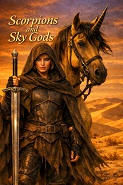
A few years ago, I embarked on a literary experiment: write a new novel, but move away from my usual preferred genres (see earlier post A Tale of Two Genres (Part I)). In summary, my previous two works were noir detective novels set around 1940. The new one: a sci-fi planetary adventure called Scorpions and Sky Gods. In it, an Earth starcruiser lieutenant is marooned on an arid world of human-like tribes and a brutal warrior culture.

I had never delved into writing sci-fi before. I almost never even read it. My usual fiction fare is mystery, action/adventure, and detective novels. On a friend's recommendation, I read A Princess of Mars, by Edgar Rice Burroughs, to get a feel for something similar. I liked the book only mildly and hoped mine would deliver a bit more action and compelling characters.

I don't have the patience to make a story outline. Besides, I suspect it'd end up constraining plot development. So, I dove right in with a thread of an idea and wrote away, letting my characters whisk me where they wished in the new alien world I had created.

Life got in the way, as it often does. Much of 2024 and 2025 became lost years where writing wasn't really an option. But later in 2025 I was able to start up again, thanks to the encouragement of my weekly writer's critique group. As the chapters accumulated, I became accustomed to my new genre. It even began to feel natural. The story progressed nicely toward the climactic ending that had taken up residence in my head from the beginning.

I finished the first draft and an initial editing pass just this month. Total 131,000 words! (I'm hoping it isn't unusual for sci-fi to be so voluminous.) My previous record - about 110,000 - was a suspense novel more than 15 years ago. Ahead, I have the inevitable second pass at editing. I've also submitted it to the Pacific Northwest Writer's Association 2026 writing contest for unpublished works, for which I am a previous winner. If I win or place this year ... maybe an agent will actually notice.

In the meantime, what do I write next? A sequel to my last noir detective novel, or one that continues my newfound planetary adventure?

Monday, June 15, 2026

Formatting Internal Dialog

Copyright © 2026, Steven E. Houchin. All rights reserved.

My writer's critique group fell into a debate about the proper formating style for a character's unspoken thoughts, or internal dialog. Some simply wrote them in first-person as a continuation of the narration, with no delineation between the two. Some just added the tag "she thought." The subject came up because, in my manuscript, a character's thoughts are italicized. They wanted to know why I did it that way. My only answer was, "That's how I see it done in books I read." That wasn't a satisfying answer for them, so I did some research.

My first resource was my trusty Chat AI that I use to critique some of my sentence phrasing. In fact, it indirectly answered the questiion before I even asked. I offered it a paragraph to critique, which included one sentence of italicized internal dialog. When I pasted the text for it to evaluate, the italics were lost. But when it regurgitated its critique, it restored the italics! So I had to ask, why? It's response: "Italics are the standard, cleanest, most widely accepted way to format a character’s unspoken first‑person thoughts in modern fiction." Okay, so that's it. Good. But then, it also added: "But there are nuances ...."

Oh, great. The old, "on the one hand ... but then on the other hand ..." dodge. It categorized two kinds of internal dialog.
  1. Direct, first‑person style - Italicize this. It's what I used: switching from third-person narration to first-person internal dialog to give the thoughts immediacy. For example: I'll be back soon enough.
  2. Free, indirect style - No italics. I use this sometimes, too, when the thoughts aren't intended to be so emphatic, but instead should flow smoothly in the narration. The thoughts remain in the narrator's third-person voice. For example: He would be back soon enough.
Reading other online sources, I see the same rules shown above. But there are other acceptable styles. For third-person POV, the "she thought" tag can be used, with the actual thought either italicized or not. But without italics, the tag must be there. For first-person POV, it's the same, but with "I thought" as the tag. The exception for this POV seems to be that it can be non-italicized and without a tag, free flowing from the narration to thoughts. I suppose that makes some sense, since first-person narration is a bit like one long thought about everything the character sees, hears, and feels.

One rule that does seem set in concrete: internal dialog is never enclosed in quotation marks. It's just too easy to mistake for the spoken word.

From what I gather, my critique-mates aren't about to change their style based upon anything I say. And I don't know if this formatting issue earns demerits in the eyes of agents, editors, or contest judges when a manuscript is evaluated.

Friday, August 11, 2023

A Tale of Two Genres (Part I)

Copyright © 2023, Steven E. Houchin. All rights reserved.

My last two novels have been mysteries, set around the year 1940. The last one centered on a hard-nosed, sarcastic gumshoe with a bunch of characters who said, "ain't," "anyways," and "we was," while grousing about broads and dames. My writer's mindset has been firmly immersed in that era and its lingo. In polite modern company, I've had to be careful not to slip into my noir characters' language patterns, lest I offend.

So, with that in mind, I just recently decided to try my hand at some futuristic sci-fi fantasy. Why? Well, a protagonist character and the skeleton of a story have been rattling around in my head (the writer's curse, I suppose) and it was time to let it out to roam free throughout my word processor. But, dear reader, you can imagine my linguistic predicament. The setting is not the mean streets of some gritty, pre-war city. The characters aren't half-educated violent mobsetrs, or dim-witted dames. No, the setting is a desert on a far away planet, filled with warriors, nomads, satraps, and evil wizards.

Thus I find myself doing the genre-switch two-step. The aliens do not speak in contractions. I suppose they'll have some form of sarcasm, but maybe it'll turn out sounding like Mork from Ork, instead of Jim Rockford. I've only written two chapters so far, but I find myself wondering if the dialog is stilted, rather than extraterrestrial.

My critique group mates are amazed after they hear my work read aloud. This just isn't something I write! The reviews have been positive so far. But as I write, the language usage is just so ... so ... alien.

Tuesday, June 9, 2020

Surprise versus Suspense, and Withholding Information

Copyright © 2020, Steven E. Houchin. All rights reserved.

As I mentioned in my last couple of blog postings, I've watched several excellent online lectures on fiction writing while on virus lockdown. One involved the complexity of plotting, which introduced a particularly intriguing concept: the contrast between surprise and suspense in a story's plot.

First of all, the instructor discussed the definition of plot versus story. A story is a series of events linked by a chronology. Told that way, the reader is led to ask, "And then …?" A plot is how a story is structured. Its events are linked by cause and effect, and are not necessarily chronological. The reader may then ask, "Why?"
In fiction, a fundamental principle of plotting is the withholding of information. At the beginning, you want the reader to know very little. At the end, the reader should know everything. In essence, the ending is withheld from the reader.

As the plot unfolds, withholding is used throughout so the reader keeps reading. The question to consider: what is withheld from whom? This is where surprise versus suspense comes in.

Surprise


In certain works of fiction, details are withheld from the reader in the beginning, and revealed bit by bit as the plot unfolds. In literary fiction, it's often details of the main character's life that are vague at first, but become clearer as the story progresses. In a mystery, the crime it known right away, with the possibilities of "whodunnit" slowly revealed. In these situations, withholding information from the reader is intended to result in the classic surprise ending, where the reader finally knows everything.

Suspense


For other works of fiction, the author tells the reader everything that is going on, but withholds details from the main characters. The reader knows the terrorist is building a bomb, then is told the target is a world leader, then is told where and when. The reader also knows the government intelligence agent has clues about the terrorist, who then figures out there's a bomb, then figures out the target, then where and when. The plot is like a slow-motion chase, where the antagonists spiral closer to an inevitable (and often predictable) confrontation. This sort of plot - with the reader knowing all, but the characters wandering in the dark and unaware of each other - is intended to create a feeling of suspense throughout the story. The reader is mostly along for the ride, with an omniscient view of everyone's movements.

So, the contrast between a story intended to surprise, versus one intended for suspense, depends upon who has been denied the crucial information. It's the reader versus the characters.

Tuesday, May 19, 2020

The Five W's of Fiction Writing

Copyright © 2020, Steven E. Houchin. All rights reserved.

In a video course on fiction writing I recently viewed, one episode was all about how to get started with a new story.

One technique it discussed comes from journalism, which the instructor called the Five W's of fiction. To get started, you'll need to think through each of these.

  1. WHO - Decide who are the main characters. Decide who is the narrator, or if many narrators are used.
  2. WHAT - What is the story about, overall? Does it have a theme? What happens in the story, as in a sequence of events? What is the desired effect on the reader? For example, to surprise, teach a moral lesson, cause an epiphany of some kind?
  3. WHERE - What is the setting? How important is it? Is it tied to a time and place? Sometimes the setting itself can be like a character. It may be crucial to the story, such as with historical fiction. It can set a mood. Or, it may be relatively unimportant.
  4. WHEN - When in history does it take place? When in the lifetime of the main character? Is the narrator past or present tense? How is the story told: from start to end chronologically, backward from the end, from middle with flashbacks?
  5. WHY - Why do characters do what they do? What does each character want? What is their motivation or causation for what they do?


The instructor also discussed the idea of outlining your story. This involves writing, in advance, a plot-point by plot-point summary of how the story unfolds. While it can be incredibly useful, many successful authors don't do it at all. Others make highly detailed outlines before writing the first word of the story. An outline can provide consistent forward momentum to the writing process. However, it can also stifle the suprise element of writing. Often, without knowing where the story is going, new characters suddenly appear, or the plot veers in an unexpected directon that wouldn't have occurred while outlining. Ultimately, the writer must decide on a case by case basis whether an outline works for her or not.

The instructor mentioned the concept of In Medias Res. It is Latin for "in the midst of things." In the case of literature, it means the story starts in the middle and is told forward from there with flashbacks to fill in what happened before. This relates to the "When" of the Five W's above, and is a common technique allowing the author to open the story with a climactic incident, and fill in the details afterward.

Overall, the course and the instructor are excellent, in my opinion.  At 24 episodes, it is well worth the investment.

Thursday, May 7, 2020

Characters, Flat Or Round, Oh My!

Copyright © 2020, Steven E. Houchin. All rights reserved.

I recently viewed a video course on fiction writing, and was fascinated by a concept regarding characters in a story: Flat characters vs Round characters. The idea comes from E.M. Forster in his 1927 book Aspects of the Novel.

First, all characters fulfill a purpose. Any minor character has, in theory, the potential to be a major character if the story is told from a different perspective. But Flat versus Round goes beyond major versus minor.

Flat Characters


Flat characters are often humorous or caricatures with just one distinguishing purpose or attribute. They are simple, predictable and vivid. They're easily recognized when they appear on stage or in the scene. But, Flats are not the same as a minor character; they can be quite important to the story.

The description of a Flat may be simple, such as, "he was a mean drunk." That character, when on stage, always predictably behaves in that way.

Sitcom characters are often Flats. For example, Cosmo Kramer in the TV show Seinfeld. His character predictably bursts into Jerry's apartment and makes some outrageous announcement, or performs some comical pratfall. Another example is Sherlock Holmes, who is, of course, a main character. But he is always predictable. What he wants is simply to solve the mystery and bask in the glow of his genius in doing so.

Round Characters


Round characters are capable of surprising in a convincing way. They are more mysterious and unpredictable. They can surprise, delight and disappoint the reader. But, any surprising outcome from them must be seen by the reader, when it occurs, as inevitable, and thus convincing.  The kindly Sister of the Blessed Poor won't be convincing if she suddenly grabs a knife and goes on a killing spree, unless a copious amount of psychological setup has been done beforehand.

A Round had the potential to change during the story, even if they miss that opportunity and fail to change. A Round can be defined by their psychology or by their circumstance.

Summary


All characters want something, and have something at stake. Flats want just one thing. Rounds are conflicted about what they want.

Wednesday, November 20, 2019

Book Review: We Have Overcome: An Immigrant's Letter to the American People

Copyright © 2019, Steven E. Houchin. All rights reserved.

In "We have Overcome ...", the author, Dr. Jason D. Hill, has written a truly inspiring and poetic story of his journey as an immigrant from Jamaica to America, and his struggle with the "progressives" among us who despise him for refusing to be categorized as a helpless minority victim of a racist nation. In many ways, his experience is a celebration of America's inclusive Conservative values where race is of little importance compared to human character and brotherhood.

Growing up in Jamaica, Hill longed to come to America to take advantage of the boundless opportunities offered by our country.  He refers to it as The Dream.  As a young man, he settled in a predominantly white section of suburban Atlanta. He worked hard at relatively low-level jobs that required little skill so as to save money to attend college. He hoped to study philosophy and poetry. In his Atlanta neighborhood, he found that the people (mostly Conservative) accepted him for who he was and were supportive of his ambitions.

Later in life, in Progressive academia, he met with dogged resistance.  Hill believed in moral virtues, hard work, and had a love for freedom and free enterprise, seeing that as the route to success.  His Progressive colleagues could not understand why he did not regard America as a land of racism and oppression, where he was doomed to fail without the affirmative action set asides of the state.  They simply refused to recognize him as a free man in control of his own destiny, one who did not need to be "emancipated" by their militancy.  His attitudes as a free thinker even led to attempts to have him fired from his academic positions, even though he had become a successful author and international speaker.

What he realized was the Progressive Left needed him to be a suffering, oppressed person of color so they (especially white Progressives) could use him (and others) to work out their own racial guilt so as to achieve some sort of personal moral redemption.  Others (people of color) saw him as a threat to their own racial militancy.  How could it be that he, Hill, could hold to Conservative values, and be free and successful?  But what Dr. Hill understood, and which befuddled the Progressives, was that Conservatives simply accepted him for who he was (a free man) and did not try to stand in his way.

In the book, Dr. Hill details similar stories of other immigrants who led their lives in pursuit of The Dream, to live free and be left alone to seek their own happiness.

My only criticism of Dr. Hill's book is his use of many $100 academic words and phrases that make some of the chapters unnecessarily verbose.  But, I suppose that's inevitable from someone who has spent years in academia. That aside, this is a remarkable book that details not only the author's love of America and its opportunities for all, but also the divisive racial impediments erected by Progressives in pursuit of their own agenda of identity politics.

Monday, September 23, 2019

Book Review: Outliers

Copyright © 2019, Steven E. Houchin. All rights reserved.

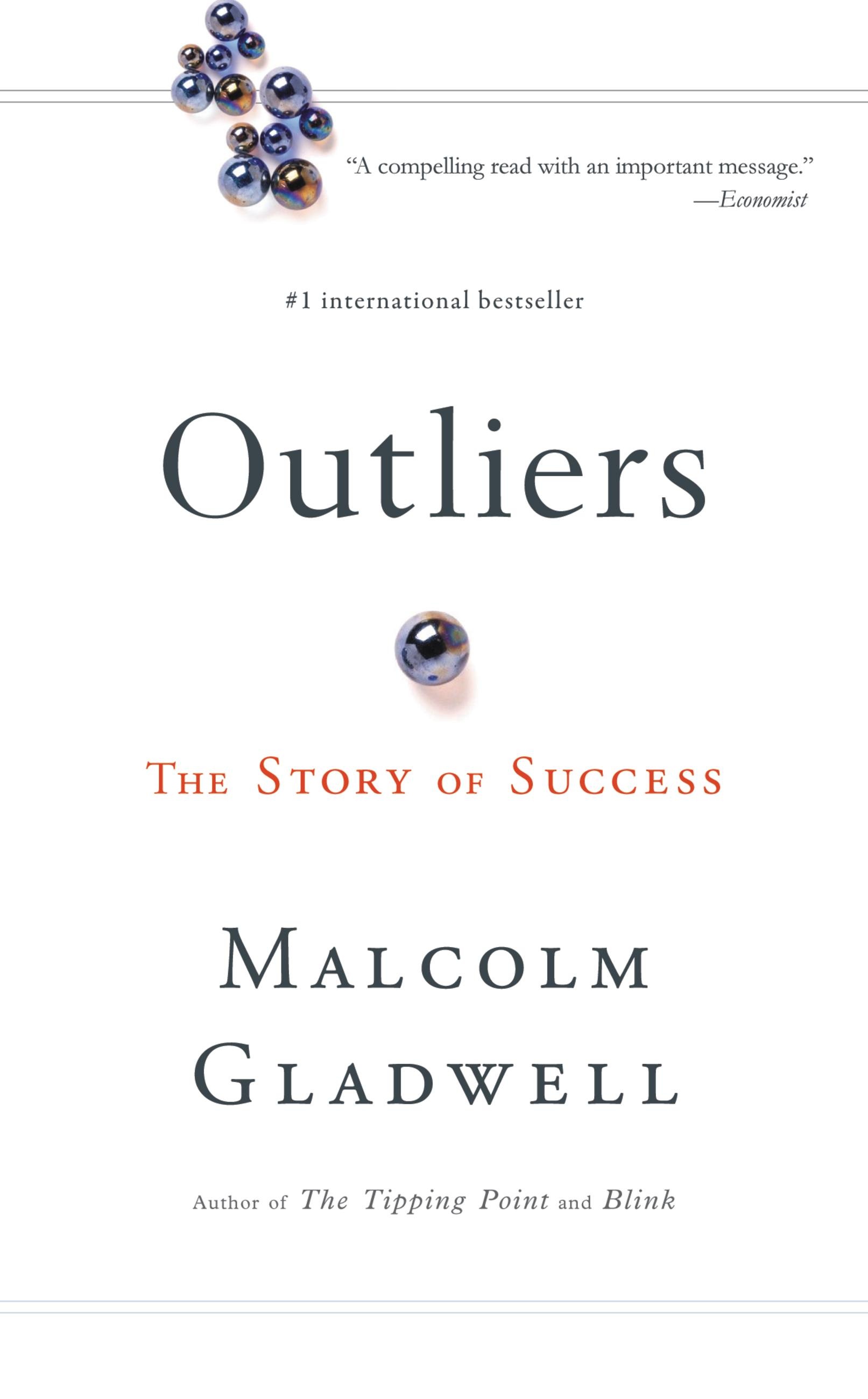
Outliers, The Story of Success, by Malcolm Gladwell, is a fascinating collection of stories about people and the factors behind their success or failure. Its basic premise is that most people succeed because of a series of circumstances that put them in the right place at the right time with the right support system.

It begins by discussing the people of the remote village of Roseto, PA, and their extraordinary healthiness. They tended to die of old age, rather than ravaged by the diseases that plague the rest of us. When studied, the researchers concluded that the sense of community amongst them - transferred from the Old Country in Italy - created an amazing wellness. No diet, or exercise, or anything else could explain it.

Later, Gladwell discusses the idea that those who succeed have had the opportunity to practice their passion, and poses that 10,000 hours of practice is a threshold at which success can happen. He gives an example of how The Beatles were given an opportunity to play in Hamburg, Germany, and were expected to perform 8 hours per day, versus other bands back home who were lucky to play a 1 hour set. Also, the example of Bill Gates who, as a high school student in the 1970s, had access to a computer at school and the University of Washington where he could write programs for hours each day, when others had no access to computers at all. The result was thousands of hours of practice, all because a fortuitous opportunity came his way.

In another study, the author discusses plane crashes, and a string of Korean Air crashes that seemed inexplicable. The result of the study was that, in cultures where challenging one's superiors is taboo, a co-pilot or other cockpit crew member was unwilling to speak up if the plane captain was making a mistake. This behavior turns out to be the cause of a large percentage of crashes. It is an example of one's culture leading to success or failure. In another example, Gladwell explains rice-growing in East Asia, which requires a 360-day work year, leading to a culture of hard work and persistence (versus other forms of agriculture with spring planting, autumn harvesting, and relative idleness in between). The rice culture has thus led to Asian's education and professional success in modern times.

This book provides fascinating insight into human behavior and how place, culture, and circumstance play a huge role in the outcomes. It is well worth reading and may help any individuals understand how they got where they are, for better or worse.

Tuesday, June 18, 2019

Observations About Literary Contest Submissions, Part III

Copyright © 2019, Steven E. Houchin. All rights reserved.

Another new year, and another new round of literary contests. So, in celebration, I thought I might offer some behind-the-scenes hints for authors who are considering a contest entry.

Some quick background. I have entered the Pacific Northwest Writers' Association's "Literary Contest for Unpublished Work" about five times, was a finalist three times, and won once for a Mystery/Thriller novel. I have also read and critiqued manuscript submissions for this contest four times, which means I was among those who provided scores for entries I read. I've written two other blog postings on this subject, Part I and Part II, so I recommend starting with those.

In this posting, I want to give you an idea what the PNWA contest readers are looking for in your submission, and the process that goes on.

The PNWA contest organizers provide the readers with guidelines, scoring forms, and critique forms to fill out. The critiques focus on key elements of the manuscript, and each of these elements receive a score from 1 to 10. The author receives a copy of the critique, but does not see the scoring. The readers/critiquers are encouraged to be positive and constructive in comments, and not to make critiques sound accusatory, such as "You need to do XYZ ..." I try to include comments that teach a concept, rather than just say something was done badly.

Here are the key elements that are critiqued and scored:
  1. Synopsis - Does it tell the story in a compelling way, and shows a plausible and original story? Does the ending feel satisfying? Does it introduce the main characters well?
  2. Viewpoint - Does each scene have an identifiable character point of view? Does it remain consistent? Does the author intrude into the narrative somehow?
  3. Characterization - Are the characters well developed, believable, distinguishable from one another, and sympathetic in some way? Are their motives clear?
  4. Dialogue - Is dialog necessary and specific to a character? Does it sound realistic? Are dialog tags used properly?
  5. Conflict/Tension/Pacing - Does the storyline keep moving forward, or does the author get mired in character backstory? Does the author show the reader rather than just tell? Do characters struggle, and is the tension raised often?
  6. Hooks/Transitions - Do scenes/chapters end so the reader feels compelled to read on to the next? Are the scene/chapter transitions done smoothly, or do things abruptly jump in time or place with no setup?
  7. Setting/Description/Narrative - Is each scene set up so the reader knows the who, where, and what of the scene? Are descriptions compelling and appropriate? Is the scene and its narration necessary to the story?
  8. Voice - Does the narrator's voice seem right for the work? For example, a Noir genre sounds different than Romance.
  9. Mechanics - Proper sentence structure, punctuation, grammar, spelling, and no typos. Does the manuscript look clean and professional?
  10. Audience Appeal - Will the intended audience be satisfied with the work? Is the writing at the appropriate level for the audience?
Of all these, I have found that many new writers have trouble setting the scene (#7) at the start of a new chapter, and have trouble writing realistic and compelling dialog (#4). Many also make the mistake of filling their Chapter One with character backstory (#5) - often boring - rather than dropping the reader right into the main plot's action.

Once the contest reader evaluates all these elements, he or she gives each one a score, then totals them up. These scores ultimately determine if your manuscript makes the cut as a top-eight finalist in your category. If you do make the finals, your submission is read and evaluated by conference-attending agents and editors, who do the final scoring for winners.

So, if you plan to enter the PNWA contest in 2019 (deadline March 22nd), you might try your own evaluation of these key elements before sending it in.

Sunday, February 3, 2019

Book Review: China Blues

Copyright © 2017, Steven E. Houchin. All rights reserved.

China Blues, by Ki Longfellow, begins by plunging the reader directly into the 1906 San Francisco earthquake, and thus into the lives of the story's main characters. Chapter One jumps ahead to 1923, where we find the same characters (some of whom were children in 1906) now living in the bustling, post-quake city.

Despite the author's stated penchant for noir mystery, I would categorize this book as literary fiction because it immerses the reader so deeply into the characters' private lives and how events change them, and because the descriptive language has such depth and richness. Right from page one, we are treated to images like, "When Los Angeles was a sun-blown pueblo waiting for the movie to begin, San Francisco was the city, a fabulous metropolis by the bay -- straight streets driven reckless up her seven steep hills of yellow sand; tall buildings perched on turbulent slopes like exclamation marks ..." And so it goes throughout the book.

I won't even attempt to describe the plot, but the there are whorehouses, jazzy nightclubs, bootlegger gangs, the mysteries of Chinatown, mobsters, street gangs, ambitious politicians, and the city's wealthy elite. They all meet up and mix up together, spiraling inward to a confrontation right about the time of a Presidential visit to the city. The author does a great job hinting at the trouble to come - whether forbidden love between a rich girl and a Chinese man, a coming war between bootlegger gangs, or political intrigue - the reader keeps turning the page for more.

The book is long - 440 pages paperback - but worth it for the excellent atmospherics, juicy characters and their relationships, historical detail, and great action scenes.

Tuesday, May 29, 2018

Book Review: The Day of Atonement

Copyright © 2017, Steven E. Houchin. All rights reserved.

The Day of Atonement, by David Liss, is set in 1755 Lisbon during the height of the Catholic Church's Inquisition. Englishman Sebastian Foxx has returned after fleeing Lisbon ten years earlier. Back then, he was thirteen year old Sebastião Reposa, a Portuguese boy whose parents were arrested by the Inquisition. A family friend whisks him off to England, where he is placed into the charge of Benjamin Weaver, a "thief-taker" (something like a private detective) whose adventures are detailed in some of Liss's earlier novels. Sebastião is brought up in Weaver's rough-and-tumble world of thieves and cutthroats, where he learns how to handle himself in tough situations.

Sebastião, now Sebastian Foxx, has returned to Lisbon posing as an ambitious English merchant, determined to exact revenge on the Inquisition's top priest, who is to blame for his parents' deaths. But he quickly discovers others who need his help. Old friends threatened by the Inquisition, the girl he loved as a child, and the man who took him to England ten years ago, who is now destitute because of swindle.

As Sebastian maneuvers to help his friends, and makes plans to kill the priest, he slowly discovers he is being manipulated by a web of lies. Friends turn out to be enemies, and visa versa. He must make atonement for wrongs he commits while acting on the lies, and figure out who can and cannot be trusted. At the climax, nature intervenes with a cataclysm that both frustrates and aids in his mission.

As usual, Liss's prose and historical research immerse the reader in the culture and era of 1755 Lisbon, making the story thoroughly believable. Sebastian Foxx is both a failure and hero at various points in his adventure, gullible to misinformation fed him, then cunning and ruthless when necessary to turn the tables. The reader can feel something is amiss, and that Foxx is being set up for a fall, but Liss keeps us guessing.

The book is 363 pages hardback, but is so engrossing it becomes a quick read you can't put down. I've read many other Liss books (see my earlier review of The Coffee Trader), and this one is as compelling as the others. Highly recommended.

Wednesday, August 23, 2017

Observations About Literary Contest Submissions, Part II

Copyright © 2017, Steven E. Houchin. All rights reserved.

Last year I posted an article titled "Observations About Literary Contest Submissions" after being asked to read and score five manuscripts submitted to the Pacific Northwest Writers Association's 2016 Literary Contest. In my posting, I outlined six guidelines and truths about submitting to literary contests, hoping the advice might help new writers who are tempted by a contest. As a two-time finalist and former winner of this contest, I thought maybe I have learned something along the way.

I put my own advice to the test again this year (2017), submitting two entries: a novel and a short story. Both received positive critiques from the first-line readers. And, the novel was chosen as a finalist! I found out in late July that I, unfortunately, did not win this time.

Being a finalist again got me thinking about the guidelines in my earlier posting, and the math involved in contests. In my article, I postulated that simply and precisely following the contest rules, and a cleanly formatted manuscript, would jump you ahead of half the others. Maybe that's an exaggeration, maybe not. But following all my six guidelines may do that and more.

Imagine if you're in a category, like Mystery, with 100 entries. If half of those fail the contest rules and neatness test, your competition drops to 50. Of those, many will fail to write a proper synopsis, maybe 10 of them. Another 20 may fail due to poor writing, such as too much backstory, mundane dialog, no description or scene setting, or a languid pace. So, maybe that 50 now drops to 20 or 25. They are your remaining competition. If the Mystery category has eight finalists, your odds become maybe 1 in 3, versus the original 8 in 100 (about 1 in 12).

Now, my numbers here are pure speculation, but are based on experience having been a reader/scorer for the PNWA contest three times. So, I've seen for myself how often author submissions fall into that bottom 75% where glaring mistakes doom their entries.

So, if you want to greatly increase your odds of being a finalist in a contest, paying attention to the details, and the experience of others, is a good start.

Monday, July 3, 2017

Backstory Blues

Copyright © 2017 Steven E. Houchin. All rights reserved.

One thing that drives me nuts as a reader is the overuse of backstory in a novel, especially when the genre is not literary fiction.

What instigated my grumbling at this time is Alex Kava's A Necessary Evil, which I'd read about one-third through. It introduces a number of characters, some of which are detectives or investigators and such, and some are perpetrators. But what I find, in chapter after chapter, is a story crawling at a snail's pace as the author plunges into the character's miserable past or dysfunctional old relationships. For example, the main character, a female FBI agent, must work with a local female detective on a murder. But in the past, the detective had made a pass at the agent, and now their working relationship is strained. Added to that, the detective once saved the agent's mother from suicide. But also, the agent had once rescued the detective's father from a serial killer. Can you say contrived? But that's just the start of boring backstories whose purpose seems mainly to fill page space and give the impression of conflict.

In my opinion, a murder mystery or suspense thriller is about the story, the plot. It's certainly mandatory to create compelling characters in a genre novel, but that can be done by showing their actions and relationships in the now - often through dialog - not by contrived family backgrounds. I'm not against giving a bit of character history, such as explaining how the protagonist became widowed, or how she inherited wealth from her industrialist father. Just weave it naturally into the story - a paragraph here and there - rather than constantly dumping out several paragraphs of the stuff time after time.

And, of course, the worst backstory sin of all: filling Chapter One with it. Arrrgh! Does anything make a reader gag more that that? Yes, sadly. Finding even more in Chapter Two.

I was having lunch with a few writer friends recently, and one author described a novel of his where the plot seemed to rely on a series of implausible character and family relationships that would do any TV soap opera proud. I cringed at the inevitable pages of backstory it must contain to untangle all the mess. And, in the end, would it have any discernable plot?

So, I did not bother finishing the last two-thirds of A Necessary Evil. I found myself skipping over paragraphs whenever a hint of dreaded backstory crept in. It just isn't worth it, wading though all that to try to get back to the actual story.

Many good articles exist online that discuss the evils of backstory done wrong and how to do it better. So I won't attempt to expound on it here. Suffice to say, it's a disease that plagues aspiring writers and experienced, published authors alike.

And please ... don't get me started on flashbacks. But, that's for another time.

Tuesday, March 28, 2017

Agents and #MSWL

Copyright © 2017 Steven E. Houchin. All rights reserved.

I ran across the MS Wish List website the other day while searching for more agents to query. It looks like a great resource. An author can select a genre and see a list of agents/editors/pubishers who are interested in that genre. And, the genre selections are numerous. After choosing a few candidate agents, I poked around a bit more on the site.

From what I can tell, this site is a filter for various Twitter hashtags related to agents/editors/publishers. The one I used to select agents by genre was #MSWL. A selection menu along the top chooses other hashtags, such as #AskAgent, #Querytip and #Pubtip, and various hashtags giving reasons why queries are accepted or rejected. I'm not sure how it all works, but I suspect the agents, etc. register on the site and then their hashtagged tweets are snagged and displayed in the proper category.

One disconcerting thing is the tweets come with no context, especially the query tweets. It gets confusing. I suppose you have to navigate to the original tweeter site to see more. Another thing: looking at the tweets shows lots of other interesting hashtags related to writing and querying (#amwriting, #amreading, #amquerying, #QueryMe).

One exciting thing I saw on the raw #MSWL Twitter site was that February 8, 2017 was proclaimed as "MSWL Day" on the site. I gather it means agents/editors/publishers were tweeting like mad what they're looking for. I was quite interested to see what it looked like, and found several leads for sending out queries.  I also saw trends that I need to keep in mind for future projects, such as women protagonists or characters/heroes from "underrepresented groups."

Wednesday, February 1, 2017

Book Review: Deadly Inheritance

Copyright © 2016, Steven E. Houchin. All rights reserved.

Sir Geoffrey Mappestone returns from the Crusades in 1103 to his family's Goodrich Castle in Herefordshire, only to find that his brother, Henry, has been murdered. His sister, Joan, his brother-in-law, and servants show no interest in finding the killer. Geoffrey learns that everyone hated Henry, who was brutal and addicted to drink. The lords of neighboring manors distrust Geoffrey because knights of the Crusade have a violent reputation.

Geoffrey is determined to find his brother's killer. But he is also nagged by Joan's demand he immediately get married and produce an heir. Without an heir, he is a likely target for murder himself by neighboring manor lords who desire to absorb his estate into theirs. So, several women are proposed as mates, none of which appeal to Geoffrey. In addition to the woes he already has, a prominent priest asks him to investigate another murder, one that happened months ago over in Normandy. Other murders soon occur, seemingly related to Henry's murder.

When later one of his neighbors launches an attack on Goodrich, Geoffrey is forced to mobilize the men of his estate into a fighting force.

The "author", Simon Beaufort (in reality a pseudonym of Susanna Gregory and Beau Riffenburgh when they write jointly), fills the pages with rich details that seem authentic for the period. They pile more and more demands on poor Geoffrey, who simply wants to live in peace on his estate. Deadly Inheritance (number six in the Mappestone series) is hard to put down as the action and mystery keep rolling on. It is definitely worth the read.

Saturday, November 19, 2016

Finding a Literary Agent to Query (Part II)

Copyright © 2016, Steven E. Houchin. All rights reserved.

I wrote earlier some tips on where and how to compile a list of literary agents who you can query for your novel (see Finding a Literary Agent to Query). I wrote it because I was doing just that for my latest novel: looking for agents who were interested in cozy mysteries.

Well, I must have done something right because last August an agent I queried asked to see the full manuscript! That is, of course, just the first step toward signing with an agency and then getting published. But it feels like a big step. Especially since, up to then, all I received for this novel from other agents was a terse, "It's not for me" response.

Now the hard part: the waiting. It is now November, and the agent has told me she's finally going to get around to reading my manuscript soon.  Hopefully, "soon" is sometime this year.

Tuesday, August 9, 2016

Finding a Literary Agent to Query

Copyright © 2016, Steven E. Houchin. All rights reserved.

The subject of literary agents came up recently with some of my aspiring writer friends. Specifically, "I'm ready to send out a query, but where do I look to find agents?"

The first and standard answer is to buy a copy of one of the Writer's Market series of books by Writer's Digest, such as Guide to Literary Agents 2016: The Most Trusted Guide to Getting Published. In addition to listing tons of agents, it has tips on queries, synopsis writing, and other how-to articles.

Another place to find agents is online information for writers conferences around the country. The organizers often prominently list the agents who are attending and what kind of works they wish to represent, such as non-fiction subjects or certain fiction genres. This will lead you to that agency's website, and once there you may browse its whole stable of agents to find an even better fit.

Another source is published authors themselves. You might attend an event at a local bookstore, where the author's work matches your genre and, if you can get some facetime with her afterward, ask for an agent recommendation. Alternatively, some authors list their agent in the book's acknowledgements up front.

Some online resources specialize in agents and agencies. One I've used is AgentQuery, which bills itself as "The internet's largest free database of literary agents." It has a cool search feature that allows you to specify a genre. It also has query tips and success stories. The site Preditors & Editors is popular and useful for checking out an agency's reputation. Its format is primitive, but it can give some comfort that the agency you're considering seems reputable. The Science Fiction Writers of America maintain a Writer Beware site that not only has great information about bad agent practices, but also has a Resources for Agent Hunting section.

Of course, you can search Google for terms like "literary agent thriller" or whatever and see what you get, then use some of the resources above to narrow down the choices.

However you choose to search, once you start looking, you should find a dozen or more prospects quickly. Then, it's a matter of researching each one to make sure they've had recent book sales, no complaints of scams, they're actually accepting queries, and the genre/subject still seems like a good match. Sometimes, you can find a recent interview with the agent posted online that may give you better insight into their likes and dislikes, their dos and don'ts, and personality.

Summary of Writing Craft Posts


Copyright © 2016, Steven E. Houchin. All rights reserved.

I've posted a lot of articles with my observations about the writing craft over the years, so figured I should post a summary of them here so they're handy in one place.


Monday, June 27, 2016

Observations About Literary Contest Submissions

Copyright © 2016, Steven E. Houchin. All rights reserved.

I was selected again this year to evaluate manuscripts submitted by aspiring writers to a local literary contest. My task was to read the submitted pages and provide a critique and a score for a half-dozen aspects, such as Dialog, Plot, Synopsis, etc. Here are some observations about what I read.
  1. Following contest guidelines is half the battle. Of the five manuscripts I was assigned, three were disqualified! The most common mistake: the author's name was included. The manuscript is supposed to be anonymous. Hello! The next mistake: too many pages were submitted. If the guidelines say 25 pages max, don't submit 30 or 40. Another: placing page numbers at the bottom, when rules called for upper right corner. Bottom line, if you simply sumbit a clean manuscript that follows all the rules to the letter, you'll jump past half the other entrants right out of the gate.
  2. Know how to properly format a manuscript. An author who wishes to be taken seriously (let alone win a contest) ought to know standard manuscript formatting rules. One entry did not indent paragraphs, but did insert blank lines between them. Another did not understand the punctuation and formatting of dialog tags. These are basic things any aspiring author learns quickly simply by reading books or having their work critiqued by a local writers group.
  3. Write a compelling synopsis. A couple of the authors clearly did not understand the concept of a synopsis. One gave an introduction for a couple of main characters, and then launched into a glowing bio of himself and his remarkable talent. And, yes, exceeded the page limit. Another introduced the main character and her conflict well, but gave vague generalities about how the plot unfolded. Most of the authors just couldn't bring themselves to give away the story's ending, which is what contest judges and literary agents expect to see. I wrote a blog article some years back about synopses ( What's In a Synopsis?) that discusses some of what I have learned about them.
  4. Some writers don't understand viewpoint. This is common for newbie writers: they don't understand the concept that a scene is normally told inside the head of one particular character. I know, because I, too, got it all wrong when first starting out. The reader should only know, see, hear, smell, feel, and think through that character's brain and senses. A few contest authors' character viewpoint wandered all over, one becoming so omniscient the narrator expounded on what will happen in the future. A corollary to wandering viewpoint is the verb tense used by the narrator: one entrant mixed present tense with past tense.
  5. Overuse of backstory. Often, the author has a good grasp of the main character, but decides to tell the reader all about the character's life and history and miserable angst in the first couple of chapters. Unfortunately, the actual plot and storyline are trampled like a cat in a stampede. One entrant used so much backstory, it was difficult to figure out what was happening in the "Now."
  6. No scene setting. I'm a big fan of telling the reader "who" and "where" and "when" in the first paragraph or so of each scene. Where are we? Who is there? What time is it? Added to that, what does the character see, hear, etc? What does the room or street look and sound like? In most of the entries, setting the scene was done poorly. Often, the author supplied reams of narration about the character's pitiful life, or launched into unbroken dialog. For me, this gives the story a disembodied feel, as if the scene takes place in a wispy white netherworld.
I could go on about trivial dialog, lack of gestures or facial expressions by characters, and slow pace. But you get the picture. Don't get me wrong. A couple of the manuscripts I read were excellent, and might even end up a contest finalist. For the others, I hope my gentle critiques encourage them on to better things. Good luck to them all.


Monday, April 18, 2016

Book Review: The Hot Country

Copyright © 2016, Steven E. Houchin. All rights reserved.

This novel by Pulitzer Prize winning author Robert Olen Butler is the first in his series billed as "A Christopher Marlowe Cobb Thriller."

The story's setting is Vera Cruz, Mexico, in 1914 where Chicago reporter Christopher Marlowe "Kit" Cobb is assigned to report on the various rebel factions that are vying for power in an unstable Mexico, made more complex by America's invasion of the southern port city of Vera Cruz.

While there, Cobb meets a pretty Mexican woman, Luisa, who turns out to be a sniper for an unknown rebel group. Also in town is a German ship filled with armaments that also disgorges, in the dead of night, a mysterious German official who Cobb thinks may be trouble for the Americans. Following the German eventually leads to Panco Villa's rebel camp, but not before Cobb has to fight alongside some Villistas to save his own skin - thus earning Pancho Villa's respect. The German is there, too, to urge Villa to invade San Antionio, Texas, and possibly unite all Mexicans under arms for the fight. Cobb learns of this and must escape to tell the story.

The author does a great job immersing the reader in the place and time of 1914 Vera Cruz, peppering the story with the smells and tastes and emotions of the locality. Each chapter bubbles with tension and suspense and action. Cobb lives on the edge at times, taking chances more suited for a secret agent than a reporter, while he tries to determine the mystery German man's mission. And along the way, he hopes to reunite with the lovely Luisa, despite the fact she once held a gun to his head.

My only negative critique of the book is a writing device Butler uses that I find annoying and ineffective: he lapses into ultra-long sentences - some spanning a page or more - for the purpose, I assume, of creating a frantic sense of action or thoughts for the character. I often found myself just skimming over those sections, having gotten the gist in the first few lines. This is done repeatedly, and I think detracts a little from the overall excellence of the story.

All in all, The Hot Country is a great read that is hard to put down. The hardcover is about 325 pages.