Showing posts with label mystery. Show all posts

Sunday, February 3, 2019

Book Review: China Blues

Copyright © 2017, Steven E. Houchin. All rights reserved.

China Blues, by Ki Longfellow, begins by plunging the reader directly into the 1906 San Francisco earthquake, and thus into the lives of the story's main characters. Chapter One jumps ahead to 1923, where we find the same characters (some of whom were children in 1906) now living in the bustling, post-quake city.

Despite the author's stated penchant for noir mystery, I would categorize this book as literary fiction because it immerses the reader so deeply into the characters' private lives and how events change them, and because the descriptive language has such depth and richness. Right from page one, we are treated to images like, "When Los Angeles was a sun-blown pueblo waiting for the movie to begin, San Francisco was the city, a fabulous metropolis by the bay -- straight streets driven reckless up her seven steep hills of yellow sand; tall buildings perched on turbulent slopes like exclamation marks ..." And so it goes throughout the book.

I won't even attempt to describe the plot, but the there are whorehouses, jazzy nightclubs, bootlegger gangs, the mysteries of Chinatown, mobsters, street gangs, ambitious politicians, and the city's wealthy elite. They all meet up and mix up together, spiraling inward to a confrontation right about the time of a Presidential visit to the city. The author does a great job hinting at the trouble to come - whether forbidden love between a rich girl and a Chinese man, a coming war between bootlegger gangs, or political intrigue - the reader keeps turning the page for more.

The book is long - 440 pages paperback - but worth it for the excellent atmospherics, juicy characters and their relationships, historical detail, and great action scenes.

Monday, July 3, 2017

Backstory Blues

Copyright © 2017 Steven E. Houchin. All rights reserved.

One thing that drives me nuts as a reader is the overuse of backstory in a novel, especially when the genre is not literary fiction.

What instigated my grumbling at this time is Alex Kava's A Necessary Evil, which I'd read about one-third through. It introduces a number of characters, some of which are detectives or investigators and such, and some are perpetrators. But what I find, in chapter after chapter, is a story crawling at a snail's pace as the author plunges into the character's miserable past or dysfunctional old relationships. For example, the main character, a female FBI agent, must work with a local female detective on a murder. But in the past, the detective had made a pass at the agent, and now their working relationship is strained. Added to that, the detective once saved the agent's mother from suicide. But also, the agent had once rescued the detective's father from a serial killer. Can you say contrived? But that's just the start of boring backstories whose purpose seems mainly to fill page space and give the impression of conflict.

In my opinion, a murder mystery or suspense thriller is about the story, the plot. It's certainly mandatory to create compelling characters in a genre novel, but that can be done by showing their actions and relationships in the now - often through dialog - not by contrived family backgrounds. I'm not against giving a bit of character history, such as explaining how the protagonist became widowed, or how she inherited wealth from her industrialist father. Just weave it naturally into the story - a paragraph here and there - rather than constantly dumping out several paragraphs of the stuff time after time.

And, of course, the worst backstory sin of all: filling Chapter One with it. Arrrgh! Does anything make a reader gag more that that? Yes, sadly. Finding even more in Chapter Two.

I was having lunch with a few writer friends recently, and one author described a novel of his where the plot seemed to rely on a series of implausible character and family relationships that would do any TV soap opera proud. I cringed at the inevitable pages of backstory it must contain to untangle all the mess. And, in the end, would it have any discernable plot?

So, I did not bother finishing the last two-thirds of A Necessary Evil. I found myself skipping over paragraphs whenever a hint of dreaded backstory crept in. It just isn't worth it, wading though all that to try to get back to the actual story.

Many good articles exist online that discuss the evils of backstory done wrong and how to do it better. So I won't attempt to expound on it here. Suffice to say, it's a disease that plagues aspiring writers and experienced, published authors alike.

And please ... don't get me started on flashbacks. But, that's for another time.

Wednesday, April 11, 2012

Book Review: Rogue Island

Copyright © 2012, Steven E. Houchin. All rights reserved.

Rogue Island is a sarcastic alias used by Rhode Island locals; an affectionate reference to the state’s rampant corruption and mob influence. In Bruce DeSilva’s excellent crime novel, jaded Providence newspaper reporter Liam Mulligan is losing at love, is harassed by his soon-to-be ex-wife, and chafes at his boss’s mundane assignment to do feel-good stories about dogs.

But somebody is burning down buildings in the Mount Hope section of Providence where Mulligan grew up. People are killed - civilians and firefighters. Mullgan knows some of them. Despite his boss’s objections, he sets off on his own investigation, not trusting the city’s arson investigators, whom he publicly belittles as Dumb and Dumber.

As the number of fires mount, Mulligan begins to doubt they’re dealing with a classic pyromaniac, despite a much-touted FBI profile of the arsonist. The fires are confined to a specific rectangle of the neighborhood. And a few obscure real estate companies have been buying up properties in the same area. Homeowners who have been approached to sell are among the arsonist’s victims.

Rogue Island lays on a heavy dose of hard-bitten language and wisecracking dialog. Mulligan find himself on everyone’s bad side as he steps on plenty of toes to push his investigation forward. The cast of characters, the clues, and the action keep coming at a brisk pace, urging the reader to keep turning the page. At about 300 pages, it is a thoroughly enjoyable quick read.

Thursday, August 18, 2011

Book Review: Strange Cargo

Copyright © 2011, Steven E. Houchin. All rights reserved.

A few years ago, I read Jeffrey Barlough’s House In the High Wood, and thoroughly enjoyed it. Recently, I read his novel Strange Cargo (third in his Western Lights series). It’s a great book, but not quite as good as the former.
Strange Cargo cover
Strange Cargo takes place in a frigid alternate Victorian-like world that in the past was rocked by the “great sundering” - a cataclysmic event that leaves mankind clinging to the mild coastal edges of an English-like civilization. The reader is introduced to three main storylines that crisscross one another as the novel goes on.

First, there is the Cargo family, from the town of Cargo, who learn from an attorney, Mr. Liffey, that they are to inherit the estate of Joseph Cargo, the grandfather of the clan. But, not all of the estate; some of it is left to an unknown Mr. Squailes of the town of Nantle. Mrs. Cargo is especially appalled at the Squailes bequest. So, they all book ship passage to Nantle to find and interrogate the “interloper Squailes.” The Cargos don’t know that Mr. Liffey is often haunted by some kind of sinister presence whenever he is alone.

Next is Miss Wastefield, who is plagued by a locked trunk that murmurs strange things to her. She cannot throw it away, because it always comes back. She travels to Nantle with her little monkey Juga after hearing from a Mr. Thistlewood who claims he can help with the trunk.

And then there is Mr. Threadneedle of Smithy Bank who, after buying some strange stones from a trader, discovers they have the power to levitate objects. So, along with his young helper Tim Christmas, he constructs a contraption within his carriage house that allows the building to fly like an airship. During test flights in the fog, a few people around Nantle spot the flying house, but aren’t believed when they report it.

As the three stories are told, the main characters cross paths with each other and numerous other cast members in and around Nantle, including a Mr. Lanthorne who seems to vanish and reappear at will; monsters called Triametes who eat humans; rooming house owner Mrs. Matchless and her other guests, and several lovable street hooligans.

Strange Cargo’s prose has a distinct old English quality that is captivating, but a bit hard to read when it reverts to the dialect of the lower classes. I found the Miss Wastefield storyline particularly unsatisfying in its resolution because it has a damsel-in-distress theme where she isn’t really saved by the hero. She does discover how the sundering occurred, but never tells anyone else (except the reader). The sundered alternate world created by the author is fascinating. His characters have an innocence and charm about them that is appealing. Strange Cargo is a definite recommended read.

Tuesday, May 10, 2011

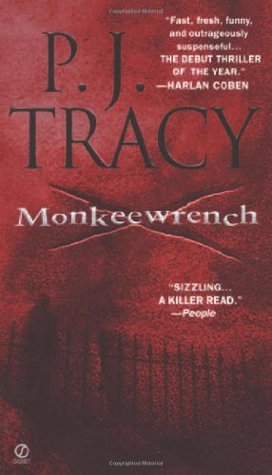
Book Review: Monkeewrench

Copyright © 2011, Steven E. Houchin. All rights reserved.

Monkeewrench is a Minneapolis software company developing a macabre game: Serial Killer Detective. When real life corpses begin to appear exactly as depicted in the game's gruesome scenarios, Detective Leo Magozzi suspects one of Monkeewrench's five employees, who all carry guns and a puzzling past: they don't seem to have one.

At the same time, over in Kingsford County, Wisconsin, Sheriff Michael Halloran struggles to solve the murder of a couple whose bodies are found in the pews of the local Catholic Church. When he and a deputy go to search their house, a rigged shotgun on the back door kills the deputy. The dead couple aren't who they seem, either.

Author P. J. Tracy (i.e. mother and daughter writing duo Patricia and Traci Lambrecht), swap back and forth between these two unconnected murder storylines until they cleverly come together when Magozzi and Halloran both follow the clues to a Catholic School in New York. The Mother Superior there casually comments to Halloran's deputy that "in all the years she's been at the school they have never once gotten a call from a law enforcement agency before, and wasn't it peculiar that this morning she had two." The two cases spiral together after that.

The novel's characters display distinct attributes and attitudes. The detectives are suitably jaded, and the Monkeewrench people are dubious of anything the police might do. The author keeps you guessing as to the culprit, leading you down multiple paths of suspicion, creeping inexorably to the big climax. Along the way, the ride-along with Magozzi and Halloran is enjoyable.

Unfortunately, the ending breaks a cardinal rule (in my opinion) of a whodunit mystery: the murderer is a minor character who is hardly seen onstage throughout the novel. Thus, the ending feels too contrived, like a Perry Mason episode where the little-seen gardener suddenly confesses on the witness stand, having some heretofore-unknown motive. Regardless, Monkeewrench is well written; a great read and worth the time you spend with it.

Monday, April 14, 2008

Murderous Prose

Copyright © 2008, Steven E. Houchin

It seems I just can't get enough of author Raymond Chandler (1888-1959). His portrayal of the hard-bitten, working class Private Dick may only be matched by his contemporary, Dashiell Hammett, with his starring ace detective Sam Spade.

Chandler is famous for his gritty detective protagonist Philip Marlowe, who prowls the streets and environs of 1930's and 1940's Los Angeles, richly transporting the reader headlong into that era. Two of his most famous Marlowe novels, Farewell, My Lovely (1940) and The Big Sleep (1939), were also successful movies.

I'm currently reading Chandler's The Simple Art of Murder (Vintage Books, 1988), which begins with an essay - often scathingly critical - on the state of the "detective story", and his disdain for its many practitioners. He says, "The average detective story is probably no worse than the average novel, but you never see the average novel. It doesn't get published." The remainder of the book is a series of - you guessed it - short detective stories.

What amazes me most about Chandler is his stunning descriptive phrases. For example, his story Spanish Blood begins:

"Big John Masters was large, fat and oily. He had sleek blue jowls and very thick fingers on which the knuckles were dimples."

Or, the first paragraph of I'll Be Waiting:

"... Carl, the night porter, turned down the last of three table lamps in the main lobby ... The blue carpet darkened a shade or two and the walls drew back into remoteness. The chairs filled with shadowy loungers. In the corners were memories like cobwebs."

Wow!