Showing posts with label book review. Show all posts

Wednesday, November 20, 2019

Book Review: We Have Overcome: An Immigrant's Letter to the American People

Copyright © 2019, Steven E. Houchin. All rights reserved.

In "We have Overcome ...", the author, Dr. Jason D. Hill, has written a truly inspiring and poetic story of his journey as an immigrant from Jamaica to America, and his struggle with the "progressives" among us who despise him for refusing to be categorized as a helpless minority victim of a racist nation. In many ways, his experience is a celebration of America's inclusive Conservative values where race is of little importance compared to human character and brotherhood.

Growing up in Jamaica, Hill longed to come to America to take advantage of the boundless opportunities offered by our country.  He refers to it as The Dream.  As a young man, he settled in a predominantly white section of suburban Atlanta. He worked hard at relatively low-level jobs that required little skill so as to save money to attend college. He hoped to study philosophy and poetry. In his Atlanta neighborhood, he found that the people (mostly Conservative) accepted him for who he was and were supportive of his ambitions.

Later in life, in Progressive academia, he met with dogged resistance.  Hill believed in moral virtues, hard work, and had a love for freedom and free enterprise, seeing that as the route to success.  His Progressive colleagues could not understand why he did not regard America as a land of racism and oppression, where he was doomed to fail without the affirmative action set asides of the state.  They simply refused to recognize him as a free man in control of his own destiny, one who did not need to be "emancipated" by their militancy.  His attitudes as a free thinker even led to attempts to have him fired from his academic positions, even though he had become a successful author and international speaker.

What he realized was the Progressive Left needed him to be a suffering, oppressed person of color so they (especially white Progressives) could use him (and others) to work out their own racial guilt so as to achieve some sort of personal moral redemption.  Others (people of color) saw him as a threat to their own racial militancy.  How could it be that he, Hill, could hold to Conservative values, and be free and successful?  But what Dr. Hill understood, and which befuddled the Progressives, was that Conservatives simply accepted him for who he was (a free man) and did not try to stand in his way.

In the book, Dr. Hill details similar stories of other immigrants who led their lives in pursuit of The Dream, to live free and be left alone to seek their own happiness.

My only criticism of Dr. Hill's book is his use of many $100 academic words and phrases that make some of the chapters unnecessarily verbose.  But, I suppose that's inevitable from someone who has spent years in academia. That aside, this is a remarkable book that details not only the author's love of America and its opportunities for all, but also the divisive racial impediments erected by Progressives in pursuit of their own agenda of identity politics.

Monday, September 23, 2019

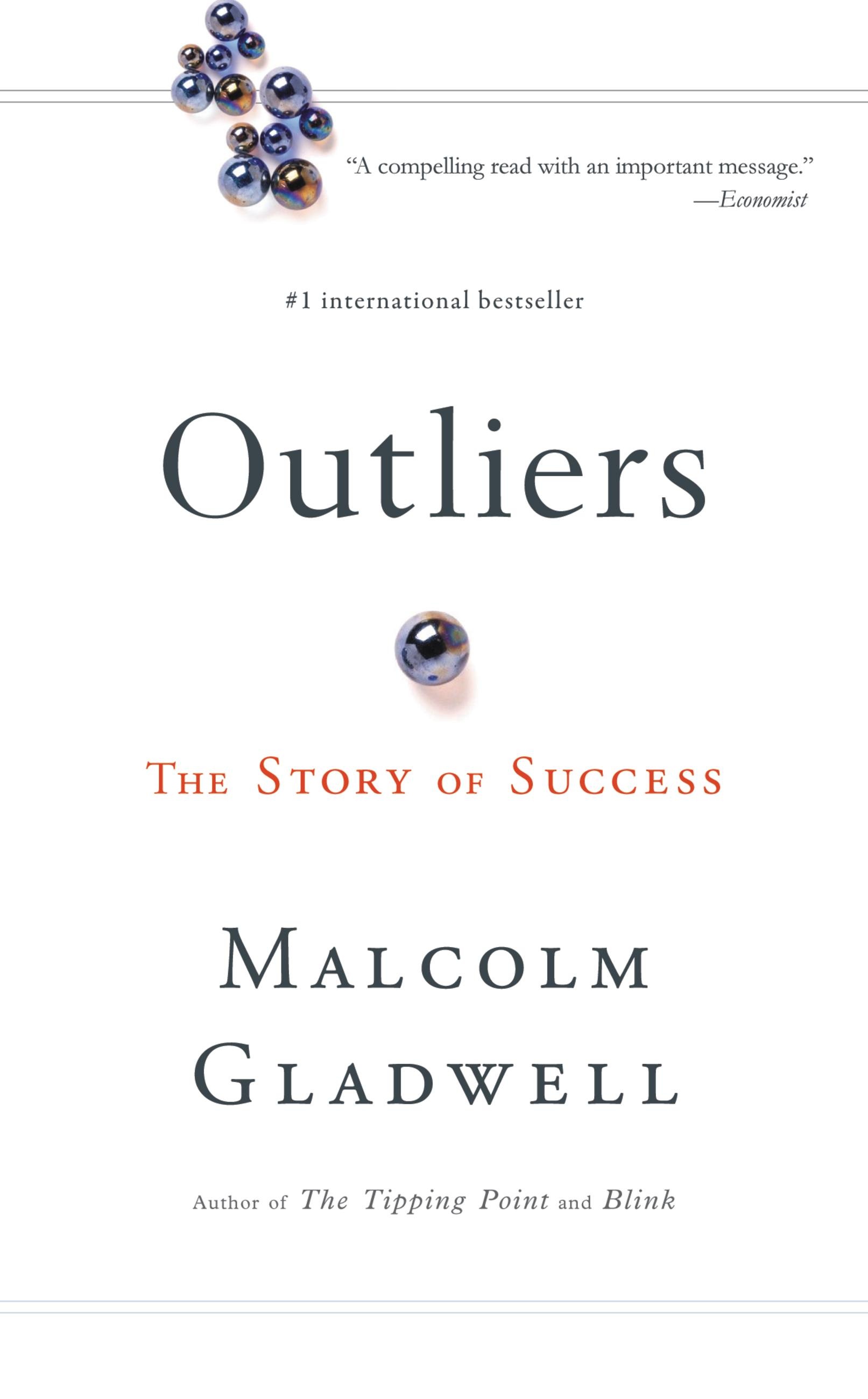
Book Review: Outliers

Copyright © 2019, Steven E. Houchin. All rights reserved.

Outliers, The Story of Success, by Malcolm Gladwell, is a fascinating collection of stories about people and the factors behind their success or failure. Its basic premise is that most people succeed because of a series of circumstances that put them in the right place at the right time with the right support system.

It begins by discussing the people of the remote village of Roseto, PA, and their extraordinary healthiness. They tended to die of old age, rather than ravaged by the diseases that plague the rest of us. When studied, the researchers concluded that the sense of community amongst them - transferred from the Old Country in Italy - created an amazing wellness. No diet, or exercise, or anything else could explain it.

Later, Gladwell discusses the idea that those who succeed have had the opportunity to practice their passion, and poses that 10,000 hours of practice is a threshold at which success can happen. He gives an example of how The Beatles were given an opportunity to play in Hamburg, Germany, and were expected to perform 8 hours per day, versus other bands back home who were lucky to play a 1 hour set. Also, the example of Bill Gates who, as a high school student in the 1970s, had access to a computer at school and the University of Washington where he could write programs for hours each day, when others had no access to computers at all. The result was thousands of hours of practice, all because a fortuitous opportunity came his way.

In another study, the author discusses plane crashes, and a string of Korean Air crashes that seemed inexplicable. The result of the study was that, in cultures where challenging one's superiors is taboo, a co-pilot or other cockpit crew member was unwilling to speak up if the plane captain was making a mistake. This behavior turns out to be the cause of a large percentage of crashes. It is an example of one's culture leading to success or failure. In another example, Gladwell explains rice-growing in East Asia, which requires a 360-day work year, leading to a culture of hard work and persistence (versus other forms of agriculture with spring planting, autumn harvesting, and relative idleness in between). The rice culture has thus led to Asian's education and professional success in modern times.

This book provides fascinating insight into human behavior and how place, culture, and circumstance play a huge role in the outcomes. It is well worth reading and may help any individuals understand how they got where they are, for better or worse.

Sunday, February 3, 2019

Book Review: China Blues

Copyright © 2017, Steven E. Houchin. All rights reserved.

China Blues, by Ki Longfellow, begins by plunging the reader directly into the 1906 San Francisco earthquake, and thus into the lives of the story's main characters. Chapter One jumps ahead to 1923, where we find the same characters (some of whom were children in 1906) now living in the bustling, post-quake city.

Despite the author's stated penchant for noir mystery, I would categorize this book as literary fiction because it immerses the reader so deeply into the characters' private lives and how events change them, and because the descriptive language has such depth and richness. Right from page one, we are treated to images like, "When Los Angeles was a sun-blown pueblo waiting for the movie to begin, San Francisco was the city, a fabulous metropolis by the bay -- straight streets driven reckless up her seven steep hills of yellow sand; tall buildings perched on turbulent slopes like exclamation marks ..." And so it goes throughout the book.

I won't even attempt to describe the plot, but the there are whorehouses, jazzy nightclubs, bootlegger gangs, the mysteries of Chinatown, mobsters, street gangs, ambitious politicians, and the city's wealthy elite. They all meet up and mix up together, spiraling inward to a confrontation right about the time of a Presidential visit to the city. The author does a great job hinting at the trouble to come - whether forbidden love between a rich girl and a Chinese man, a coming war between bootlegger gangs, or political intrigue - the reader keeps turning the page for more.

The book is long - 440 pages paperback - but worth it for the excellent atmospherics, juicy characters and their relationships, historical detail, and great action scenes.

Tuesday, May 29, 2018

Book Review: The Day of Atonement

Copyright © 2017, Steven E. Houchin. All rights reserved.

The Day of Atonement, by David Liss, is set in 1755 Lisbon during the height of the Catholic Church's Inquisition. Englishman Sebastian Foxx has returned after fleeing Lisbon ten years earlier. Back then, he was thirteen year old Sebastião Reposa, a Portuguese boy whose parents were arrested by the Inquisition. A family friend whisks him off to England, where he is placed into the charge of Benjamin Weaver, a "thief-taker" (something like a private detective) whose adventures are detailed in some of Liss's earlier novels. Sebastião is brought up in Weaver's rough-and-tumble world of thieves and cutthroats, where he learns how to handle himself in tough situations.

Sebastião, now Sebastian Foxx, has returned to Lisbon posing as an ambitious English merchant, determined to exact revenge on the Inquisition's top priest, who is to blame for his parents' deaths. But he quickly discovers others who need his help. Old friends threatened by the Inquisition, the girl he loved as a child, and the man who took him to England ten years ago, who is now destitute because of swindle.

As Sebastian maneuvers to help his friends, and makes plans to kill the priest, he slowly discovers he is being manipulated by a web of lies. Friends turn out to be enemies, and visa versa. He must make atonement for wrongs he commits while acting on the lies, and figure out who can and cannot be trusted. At the climax, nature intervenes with a cataclysm that both frustrates and aids in his mission.

As usual, Liss's prose and historical research immerse the reader in the culture and era of 1755 Lisbon, making the story thoroughly believable. Sebastian Foxx is both a failure and hero at various points in his adventure, gullible to misinformation fed him, then cunning and ruthless when necessary to turn the tables. The reader can feel something is amiss, and that Foxx is being set up for a fall, but Liss keeps us guessing.

The book is 363 pages hardback, but is so engrossing it becomes a quick read you can't put down. I've read many other Liss books (see my earlier review of The Coffee Trader), and this one is as compelling as the others. Highly recommended.

Monday, July 3, 2017

Backstory Blues

Copyright © 2017 Steven E. Houchin. All rights reserved.

One thing that drives me nuts as a reader is the overuse of backstory in a novel, especially when the genre is not literary fiction.

What instigated my grumbling at this time is Alex Kava's A Necessary Evil, which I'd read about one-third through. It introduces a number of characters, some of which are detectives or investigators and such, and some are perpetrators. But what I find, in chapter after chapter, is a story crawling at a snail's pace as the author plunges into the character's miserable past or dysfunctional old relationships. For example, the main character, a female FBI agent, must work with a local female detective on a murder. But in the past, the detective had made a pass at the agent, and now their working relationship is strained. Added to that, the detective once saved the agent's mother from suicide. But also, the agent had once rescued the detective's father from a serial killer. Can you say contrived? But that's just the start of boring backstories whose purpose seems mainly to fill page space and give the impression of conflict.

In my opinion, a murder mystery or suspense thriller is about the story, the plot. It's certainly mandatory to create compelling characters in a genre novel, but that can be done by showing their actions and relationships in the now - often through dialog - not by contrived family backgrounds. I'm not against giving a bit of character history, such as explaining how the protagonist became widowed, or how she inherited wealth from her industrialist father. Just weave it naturally into the story - a paragraph here and there - rather than constantly dumping out several paragraphs of the stuff time after time.

And, of course, the worst backstory sin of all: filling Chapter One with it. Arrrgh! Does anything make a reader gag more that that? Yes, sadly. Finding even more in Chapter Two.

I was having lunch with a few writer friends recently, and one author described a novel of his where the plot seemed to rely on a series of implausible character and family relationships that would do any TV soap opera proud. I cringed at the inevitable pages of backstory it must contain to untangle all the mess. And, in the end, would it have any discernable plot?

So, I did not bother finishing the last two-thirds of A Necessary Evil. I found myself skipping over paragraphs whenever a hint of dreaded backstory crept in. It just isn't worth it, wading though all that to try to get back to the actual story.

Many good articles exist online that discuss the evils of backstory done wrong and how to do it better. So I won't attempt to expound on it here. Suffice to say, it's a disease that plagues aspiring writers and experienced, published authors alike.

And please ... don't get me started on flashbacks. But, that's for another time.

Wednesday, February 1, 2017

Book Review: Deadly Inheritance

Copyright © 2016, Steven E. Houchin. All rights reserved.

Sir Geoffrey Mappestone returns from the Crusades in 1103 to his family's Goodrich Castle in Herefordshire, only to find that his brother, Henry, has been murdered. His sister, Joan, his brother-in-law, and servants show no interest in finding the killer. Geoffrey learns that everyone hated Henry, who was brutal and addicted to drink. The lords of neighboring manors distrust Geoffrey because knights of the Crusade have a violent reputation.

Geoffrey is determined to find his brother's killer. But he is also nagged by Joan's demand he immediately get married and produce an heir. Without an heir, he is a likely target for murder himself by neighboring manor lords who desire to absorb his estate into theirs. So, several women are proposed as mates, none of which appeal to Geoffrey. In addition to the woes he already has, a prominent priest asks him to investigate another murder, one that happened months ago over in Normandy. Other murders soon occur, seemingly related to Henry's murder.

When later one of his neighbors launches an attack on Goodrich, Geoffrey is forced to mobilize the men of his estate into a fighting force.

The "author", Simon Beaufort (in reality a pseudonym of Susanna Gregory and Beau Riffenburgh when they write jointly), fills the pages with rich details that seem authentic for the period. They pile more and more demands on poor Geoffrey, who simply wants to live in peace on his estate. Deadly Inheritance (number six in the Mappestone series) is hard to put down as the action and mystery keep rolling on. It is definitely worth the read.

Monday, April 18, 2016

Book Review: The Hot Country

Copyright © 2016, Steven E. Houchin. All rights reserved.

This novel by Pulitzer Prize winning author Robert Olen Butler is the first in his series billed as "A Christopher Marlowe Cobb Thriller."

The story's setting is Vera Cruz, Mexico, in 1914 where Chicago reporter Christopher Marlowe "Kit" Cobb is assigned to report on the various rebel factions that are vying for power in an unstable Mexico, made more complex by America's invasion of the southern port city of Vera Cruz.

While there, Cobb meets a pretty Mexican woman, Luisa, who turns out to be a sniper for an unknown rebel group. Also in town is a German ship filled with armaments that also disgorges, in the dead of night, a mysterious German official who Cobb thinks may be trouble for the Americans. Following the German eventually leads to Panco Villa's rebel camp, but not before Cobb has to fight alongside some Villistas to save his own skin - thus earning Pancho Villa's respect. The German is there, too, to urge Villa to invade San Antionio, Texas, and possibly unite all Mexicans under arms for the fight. Cobb learns of this and must escape to tell the story.

The author does a great job immersing the reader in the place and time of 1914 Vera Cruz, peppering the story with the smells and tastes and emotions of the locality. Each chapter bubbles with tension and suspense and action. Cobb lives on the edge at times, taking chances more suited for a secret agent than a reporter, while he tries to determine the mystery German man's mission. And along the way, he hopes to reunite with the lovely Luisa, despite the fact she once held a gun to his head.

My only negative critique of the book is a writing device Butler uses that I find annoying and ineffective: he lapses into ultra-long sentences - some spanning a page or more - for the purpose, I assume, of creating a frantic sense of action or thoughts for the character. I often found myself just skimming over those sections, having gotten the gist in the first few lines. This is done repeatedly, and I think detracts a little from the overall excellence of the story.

All in all, The Hot Country is a great read that is hard to put down. The hardcover is about 325 pages.

Monday, February 15, 2016

Book Review: The Nomination

Copyright © 2016, Steven E. Houchin. All rights reserved.

This suspense novel by William G. Tapply employs a story technique I used in my first novel, Linear Descent, that I think of as the "character spiral." If you consider a spiral shape, such as a galaxy in space, it consists of numerous far-flung entities circling a center point, all drawn toward the center. At some point, they swirl inward and converge at that center, crashing together. In a character spiral, the entities are a cast of characters separated by distance, time, or unfamiliarity (i.e. strangers).

In The Nomination, the main characters are out at the edge of the spiral, living separated lives, with only tangential relationship. The center point, or the inciting incident in novelist terms, is the impending retirement of a Supreme Court justice. The president wants to appoint Massachusetts judge Thomas Larrigan, who is considered a Vietnam War hero with a squeaky-clean record. But Larrigan has a secret past: during the war, he abandoned a child bride and a gave away their baby for adoption. He connects with an old Marine pal, Eddie, who knows all about it. Eddie's old girlfriend knows, too, and Larrigan sends him down to Florida to take care of her.

In New York, that former child bride, Simone, is now a dying woman who agrees to let a ghostwriter tell her story. She'd had a brief acting career in the 1980s, becoming a cult celebrity before retiring due to her illness. She has the documents from her past, and a just-arrived package of photos sent to her by Eddie's girlfriend, who has been spooked by his sudden appearance in Florida.

Out in California, former police detective Jesse Church fears for her life after sending a mob boss to jail. After her picture appears in the paper, she goes on the run, but not before receiving a letter from Simone who believes Jesse to be her birth-daughter. So, Jesse heads for New York, thinking the mob hit-men won't find her there.

Writer Mac Cassidy gets the job to ghostwrite Simone's biography. He meets her and leaves behind a tape recorder that she'll use to dictate the story. She has no idea Thomas Larrigan is a judge and that he's been nominated for the high court. But, Eddie has found out about her from his long-ago girlfriend.

And so the characters spiral in toward one another, and the reader anticipates the impending crash that will happen when they meet. Mac has the tapes and photos, Eddie wants to silence Simone and get the photos (unaware of the book project), and Jesse wants to meet her mother and hide out, and the mob is on her trail. The reader has an inkling about what will happen, yet the outcome isn't exactly as expected. All in all, The Nomination is well worth the read. The hardcover is about 300 pages, so not too long.

Tuesday, June 23, 2015

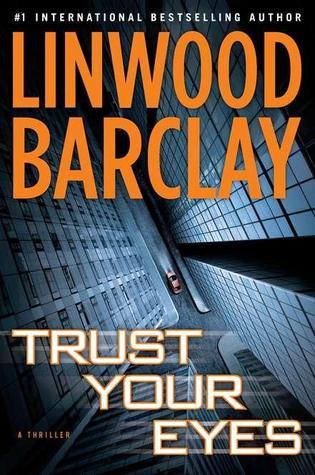
Book Review: Trust Your Eyes

Copyright © 2015, Steven E. Houchin. All rights reserved.

Author Lynwood Barclay's 2012 thriller Trust Your Eyes begins where any thriller or mystery should, with what we writers call "the inciting incident."  In this case, mildly schizophrenic Thomas Kilbride believes he sees a murder online.

Thomas is obsessed with maps. The walls of his room and the hallway outside are papered with them. He believes some cataclysm will wipe out all online maps, and he'll be the only one left with paper ones. He discovers a web site named Whirl360 (a thinly veiled reference to Google Street View) that allows him to "walk" streets around the world.  So, he spends all day in his room web-walking Whirl360's streets to memorize everything he sees, which he has the brilliance to do.

Trust Your Eyes image
One day, while web-walking a street in New York City, he looks up at an apartment building window and sees a person's head. A plastic bag is squeezed tightly over it.  A murder in progress, frozen in time by Whirl360's drive-by camera.  Thomas convinces his skeptical brother, Ray, to travel to New York City to investigate.  Ray discovers nothing unusual. The apartment is empty and he's told the girls who lived there have moved away.  He does nothing to dig deeper, but his arrival asking questions is noticed by the wrong people - those who ordered the murder.

The murder is orchestrated by Howard Talliman, the campaign strategist of an ambitious politician, to cover up previous dirty deeds by the politician, who plans to run for governor. Ray's snooping leads Howard's henchman to the picture in Whirl360.  Stunned by what they see, they decide the image must be scrubbed out. He sends a hit woman to the Whirl360 headquarters, who then forces the engineer in charge to wipe the image of the head from the picture before killing him and his wife.

When the head image suddenly disappears from Whirl360, Ray is convinced Thomas was right. It was a murder, and someone made the change just after his visit to New York.

As the story progresses, Howard's henchman tries to find Ray's identity, while at the same time Ray, Thomas, and a friend attempt to discover all they can about the murder so they can take a convincing story to the police.  The tension grows as Howard's operatives discover Ray's whereabouts and set out to eliminate them as loose ends.

Trust Your Eyes keeps you engaged all along, and includes other subplots that entangle Ray as he and Thomas struggle with the murder mystery.

Wednesday, April 11, 2012

Book Review: Rogue Island

Copyright © 2012, Steven E. Houchin. All rights reserved.

Rogue Island is a sarcastic alias used by Rhode Island locals; an affectionate reference to the state’s rampant corruption and mob influence. In Bruce DeSilva’s excellent crime novel, jaded Providence newspaper reporter Liam Mulligan is losing at love, is harassed by his soon-to-be ex-wife, and chafes at his boss’s mundane assignment to do feel-good stories about dogs.

But somebody is burning down buildings in the Mount Hope section of Providence where Mulligan grew up. People are killed - civilians and firefighters. Mullgan knows some of them. Despite his boss’s objections, he sets off on his own investigation, not trusting the city’s arson investigators, whom he publicly belittles as Dumb and Dumber.

As the number of fires mount, Mulligan begins to doubt they’re dealing with a classic pyromaniac, despite a much-touted FBI profile of the arsonist. The fires are confined to a specific rectangle of the neighborhood. And a few obscure real estate companies have been buying up properties in the same area. Homeowners who have been approached to sell are among the arsonist’s victims.

Rogue Island lays on a heavy dose of hard-bitten language and wisecracking dialog. Mulligan find himself on everyone’s bad side as he steps on plenty of toes to push his investigation forward. The cast of characters, the clues, and the action keep coming at a brisk pace, urging the reader to keep turning the page. At about 300 pages, it is a thoroughly enjoyable quick read.

Wednesday, December 28, 2011

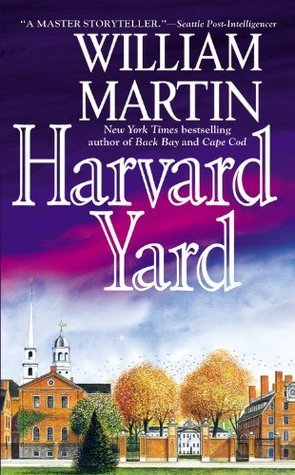
Book Review: Harvard Yard

Copyright © 2011, Steven E. Houchin. All rights reserved.

Part of his Peter Fallon series, Willian Martin has crafted a fascinating novel that follows a Boston family with a secret through many generations.

In 1604, Robert Harvard turns to his friend Will Shakespeare, needing advice on just the right words to express his love for Katherine Rogers. Shakespeare conjures up a few phrases, such as “Shall I compare thee to a summer’s day?” Two years later, Will Shakespeare gives the couple a gift for their new son, John: a handwritten play named Love’s Labors Won, a companion to another play, Love’s Labors Lost. In 1625, when the plague is about to take Robert’s life, he tells his son “a man is known by his books”, and extracts a promise that John will cherish all of Robert’s books, especially Love’s Labors Lost.

Twelve years later, John Harvard arrives in Puritan Boston, bringing with him his father’s books. Thus begins a story of the founding of Harvard College and a missing Shakespeare play that spans 400 years, told through the lives of the fictional Wedge family of Cambridge, Massachusetts.

In 1638, John Harvard dies at 30 without an heir and wills his trunks of books to a student he had sponsored at the new college, Issac Wedge, and also gives an £800 donation to the college itself. When cataloging the books, Isaac discovers the play and decides it must be hidden from the Puritans, who believe plays are evil.

In the present day, antiquarian book dealer Peter Fallon is on the trail of the possible lost play. But, he soon finds others will kill to possess it. As Fallon discovers each new clue to its location, the scene changes to the past - and another Wedge descendant - where the origin of that clue is revealed.

Harvard Yard is a long read (600 pages or so), but well worth it if you like historical novels.

Saturday, October 22, 2011

PNWA Author Panel: Poisoned Pen Press

Copyright © 2011, Steven E. Houchin. All rights reserved.

Last month, I attended the September member meeting of the Pacific Northwest Writer’s Association. The program consisted of a five-person panel of authors who have published books with Poisoned Pen Press of Scottsdale, AZ, which is an independent publisher of various mystery genres. According to the panelists, the editors are Barbara Peters and Annette Rogers. Unlike the big New York publishers, they take unagented submissions. They accept works between 60,000 and 90,000 words.poisoned pen press logo

The panelists raved about how the editors spent a lot of time with them to get their book just right. In general, they recommend that authors start out querying small, independent presses because the author has a good chance of receiving good feedback on their work, even if rejected. Like any other publisher or agent, 99% of submissions will be rejected; they receive a lot of poorly-written submissions.

Poisoned Pen’s advances aren’t large: about $1000. But, there isn’t a lot of deadline pressure, and they won’t necessarily drop you as an author because of poor sales. After your book’s first print run, they utilize Print On Demand for subsequent orders, and distribute through Ingram Publisher Services. This means your book never goes out of print. From day one, your book is published in hardcover, trade paperback, audiobook, and large print.

On the subject of marketing your book, the panelists emphasized the importance of sending out advance, pre-publication review copies to the big industry reviewers, such as Library Journal or Booklist. Poisoned Pen will send out the review copies. Once the book is published, these reviewers will not look at the book. They only review advance copies. Unfortunately, most newspspers no longer review books. Ones that do: LA Times, Seattle Times, Washington Post.

Also attending the meeting was a man (I didn’t get his name) from New Libri Press, a small publisher in Mercer island, WA.

Thursday, September 22, 2011

Book Review: Operation Mincemeat

Copyright © 2011, Steven E. Houchin. All rights reserved.

The subtitle of this non-fiction book draws you right in: How a Dead Man and a Bizarre Plan Fooled the Nazis and Assured an Allied Victory. Author Ben MacIntyre doesn’t disappoint in this true tale of British intelligence operatives who came up with an ingenious scheme to deceive the Nazis.

The year is 1943. The Allies have defeated the Nazi army in North Africa and are planning their next strike at the Axis: the invasion of Italy. If successful, they hope to knock Italy out of the war and secure Allied naval dominance of the Mediterranean. But the key to victory in Italy first requires the conquest of the island of Sicily, so that its large contingent of German and Italian troops and planes aren’t left in the Allies’ rear during the campaign. An attack on Sicily was obvious. Everyone knew it, including the Germans, who were expected to massively fortify it in advance, making its invasion a costly, bloody affair.book cover

Enter a couple of screwball-thinking intelligence officers in London: Ewen Montague and Charles Cholmondeley. They came up with an audacious and risky plan to make the Germans think the Allied attack would occur in Sardinia and Greece: dress up a corpse as a high-ranking military officer, plant fake invasion documents on it, drop it in the sea, and let it float into enemy hands. Operation Mincemeat was born.

MacIntyre’s book is filled with wry humor and short biographies of the numerous characters involved as he describes in amazing detail the operation’s inception, planning, execution and aftermath. He tells of the trouble finding and preserving a suitable corpse whose body won’t be missed; the planning for how to drop a corpse at sea so that it will drift to just the right target area (in Spain) where it is sure to be noticed by Germans (but not be too obvious); and the anxiety whether the Germans will buy the ruse and reposition their forces.

Once I started reading, I couldn’t put the book down, finishing in just a couple of days. The research to uncover all the details seems to be exhaustive. The history is fascinating, and the characters colorful and believable. It even mentions the participation of a British intelligence officer named Ian Fleming, the creator of James Bond.

Even though Operation Mincemeat is non-fiction, it reads like a spy thriller and is definitely worth the read.

Thursday, August 18, 2011

Book Review: Strange Cargo

Copyright © 2011, Steven E. Houchin. All rights reserved.

A few years ago, I read Jeffrey Barlough’s House In the High Wood, and thoroughly enjoyed it. Recently, I read his novel Strange Cargo (third in his Western Lights series). It’s a great book, but not quite as good as the former.
Strange Cargo cover
Strange Cargo takes place in a frigid alternate Victorian-like world that in the past was rocked by the “great sundering” - a cataclysmic event that leaves mankind clinging to the mild coastal edges of an English-like civilization. The reader is introduced to three main storylines that crisscross one another as the novel goes on.

First, there is the Cargo family, from the town of Cargo, who learn from an attorney, Mr. Liffey, that they are to inherit the estate of Joseph Cargo, the grandfather of the clan. But, not all of the estate; some of it is left to an unknown Mr. Squailes of the town of Nantle. Mrs. Cargo is especially appalled at the Squailes bequest. So, they all book ship passage to Nantle to find and interrogate the “interloper Squailes.” The Cargos don’t know that Mr. Liffey is often haunted by some kind of sinister presence whenever he is alone.

Next is Miss Wastefield, who is plagued by a locked trunk that murmurs strange things to her. She cannot throw it away, because it always comes back. She travels to Nantle with her little monkey Juga after hearing from a Mr. Thistlewood who claims he can help with the trunk.

And then there is Mr. Threadneedle of Smithy Bank who, after buying some strange stones from a trader, discovers they have the power to levitate objects. So, along with his young helper Tim Christmas, he constructs a contraption within his carriage house that allows the building to fly like an airship. During test flights in the fog, a few people around Nantle spot the flying house, but aren’t believed when they report it.

As the three stories are told, the main characters cross paths with each other and numerous other cast members in and around Nantle, including a Mr. Lanthorne who seems to vanish and reappear at will; monsters called Triametes who eat humans; rooming house owner Mrs. Matchless and her other guests, and several lovable street hooligans.

Strange Cargo’s prose has a distinct old English quality that is captivating, but a bit hard to read when it reverts to the dialect of the lower classes. I found the Miss Wastefield storyline particularly unsatisfying in its resolution because it has a damsel-in-distress theme where she isn’t really saved by the hero. She does discover how the sundering occurred, but never tells anyone else (except the reader). The sundered alternate world created by the author is fascinating. His characters have an innocence and charm about them that is appealing. Strange Cargo is a definite recommended read.

Friday, June 17, 2011

Book Review: Bel Canto

Copyright © 2011, Steven E. Houchin. All rights reserved.

Ann Patchett's award-winning novel Bel Canto takes place in a Latin American nation, where attendees at a birthday party in the Vice President's mansion find themselves taken hostage by a rebel force.  The rebels plan to kidnap the President.  But he canceled his attendance at the last minute to stay home and watch his favorite TV soap opera.  The rebels aren't sure what to do, so they hold onto the most prominent men and the one woman at the party who matters: opera singer Roxane Coss, who was the party's entertainment.  Weeks go by.  Negotiations are stalled.  The rebels' strict regimen toward the hostages slackens, and life inside the mansion becomes a small, insular world of its own as hostages and some of the younger rebels bond.  Roxane Coss, deciding she must sing to keep her voice strong, practices her opera daily - delighting rebels and hostages alike.  Life outside the compound is nearly forgotten.  The standoff will never end, they think, so this is all there is.

The entire story takes place in the mansion.  As the story goes on, we see numerous characters contribute their own skills to the smooth operation of their new world.  A pianist.  A cook.  A translator.  The Vice President, who essentially becomes the housekeeper.  Many of the young rebels, who have lived only in the backwoods, learn about society and luxury they've never imagined before, such as watching TV for the first time.   One character, a multilingual Japanese translator named Gen, falls in love with Carmen, one of the young rebels.

Patchett does a masterful job of developing each character without dumping loads of backstory on the reader.  The reader feels sympathy for a General with the disease shingles, which causes an ugly, painful rash on his face. Or Cesar, who learns he can sing opera beautifully.  Or Carmen, who helps Roxane Coss arrange an amorous tryst with a Japanese businessman.  The reader begins to live vicariously in the little false world of the hostages, which is bound to come to a tragic end.

Patchett's language is lyrical, the descriptions rich and humorous at times.  She does not stick to any one character's point-of-view, but rather lets it flow from one person to the next, paragraph by paragraph - and makes it work.

If you long for a novel that explores complex situational character relationships, Bel Canto is worth your time.

Tuesday, May 10, 2011

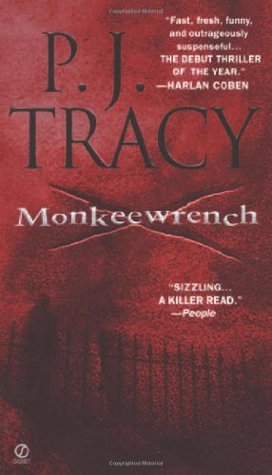
Book Review: Monkeewrench

Copyright © 2011, Steven E. Houchin. All rights reserved.

Monkeewrench is a Minneapolis software company developing a macabre game: Serial Killer Detective. When real life corpses begin to appear exactly as depicted in the game's gruesome scenarios, Detective Leo Magozzi suspects one of Monkeewrench's five employees, who all carry guns and a puzzling past: they don't seem to have one.

At the same time, over in Kingsford County, Wisconsin, Sheriff Michael Halloran struggles to solve the murder of a couple whose bodies are found in the pews of the local Catholic Church. When he and a deputy go to search their house, a rigged shotgun on the back door kills the deputy. The dead couple aren't who they seem, either.

Author P. J. Tracy (i.e. mother and daughter writing duo Patricia and Traci Lambrecht), swap back and forth between these two unconnected murder storylines until they cleverly come together when Magozzi and Halloran both follow the clues to a Catholic School in New York. The Mother Superior there casually comments to Halloran's deputy that "in all the years she's been at the school they have never once gotten a call from a law enforcement agency before, and wasn't it peculiar that this morning she had two." The two cases spiral together after that.

The novel's characters display distinct attributes and attitudes. The detectives are suitably jaded, and the Monkeewrench people are dubious of anything the police might do. The author keeps you guessing as to the culprit, leading you down multiple paths of suspicion, creeping inexorably to the big climax. Along the way, the ride-along with Magozzi and Halloran is enjoyable.

Unfortunately, the ending breaks a cardinal rule (in my opinion) of a whodunit mystery: the murderer is a minor character who is hardly seen onstage throughout the novel. Thus, the ending feels too contrived, like a Perry Mason episode where the little-seen gardener suddenly confesses on the witness stand, having some heretofore-unknown motive. Regardless, Monkeewrench is well written; a great read and worth the time you spend with it.

Saturday, March 5, 2011

Book Review: The Treasure of Israel


Copyright © 2011, Steven E. Houchin. All rights reserved.

Where do I begin with S. J. Munson's novel, The Treasure of Israel? From the first pages, the words sloppy, amateurish came to mind. The formatting is jarring, almost as if the author's rough manuscript was dumped into a book-espresso machine and vomited out as-is. Blank lines separate paragraphs. Scene breaks are marked (or is it marred?) by multiple blank lines and gaggles of asterisks.  The use of dashes is seriously inconsistent (some long, some short). Was no editing done by the publisher, Revival Nation Publishing of Ontario? Well, considering their web site is defunct, it's hard to tell the quality of their products. One profile of them indicates they dedicate profits to Christian ministry work -- a laudable goal, but no excuse for a sloppy end product. Maybe it is strictly vanity publishing.

To say the novel's characters are thin is an insult to all thin characters ever created. To quote Admiral Nimitz (Henry Fonda) from the movie Midway when discussing Objective A-F: "Thin? Damn near invisible!"  The main character is Michael Grammaticus, not to be confused with his father from the opening chapter, Michael Grammaticus. The storyline has a poor man's Da Vinci Code feel to it, where a secret left behind by the deceased Michael Sr. propels Michael Jr. into danger and intrigue following clues among Rome's ancient churches. And we have, of course, the obligatory accidental female sidekick babe who latches on for the ride. The dialog among the characters usually consists of pointless arguments and dribbling banter that pretends to be clever but fails miserably.

The only interesting part for me were the flashbacks that detailed the history behind the treasures of the ancient temple of Israel. If those portions are true, then it represents a significant body of research.  But, who knows how much is just made up?

Dive into a good Clive Cussler novel instead.  The Treasure of Israel is definitly a book to skip.

Book Review: Summer's Lease

Copyright © 2011, Steven E. Houchin. All rights reserved.

I recently finished John Mortimer's literary novel Summer's Lease. At first glance, it would seem to be another tedious story of a dysfunctional family. I was pleasantly surprised when plot elements of mystery and intrigue were introduced early.

The main character, Molly Pargeter, lives in England. She is "big-boned", has led a dull life lacking in ambition, and admires Italian paintings. She arranges a long summer vacation in Tuscany for her family: husband Hugh and the children. The arrangements are made by letter correspondence with a mysterious S. Kettering, who gives Molly precise, detailed instructions about use of his villa "La Felicita", such as "Above all, avoid flushing the lavatory next to the small sitting-room more than once in any given half hour or serious results may follow." Much to her chagrin, her gadfly father, Haverford Downs, manages to invite himself along. He writes a declining column for a low-rent publication, the Informer, convincing the editor that Tuscany was just the place to inspire his writing.

Once in Tuscany at La Felicita, Molly begins to notice odd happenings, the most dramatic of which is the sudden lack of water at the villa, including the remarkable disappearance of the pool's water overnight. She also becomes obsessed with meeting her landlord, S. Kettering, after finding a cryptic note that seems to indicate his imminent murder.

The story pulls the reader along from one curious event to another, as Molly's determination grows to find answers to the mysteries she sees. Along the way, her father makes mischeif, a murder happens, and Molly finds out her husband has been hiding something from her. The language is deliciously English, and there is a good cast of bit-players who keep things interesting.

Summer's Lease will keep you turning the page.

Tuesday, December 7, 2010

Book Review: Border Songs

Copyright © 2010, Steven E. Houchin

Jim Lynch’s Border Songs is a work of literary fiction set in the Blaine, Washington area along the USA/Canada border.  The main character is an unlikely Border Patrol agent named Brandon Vanderkool.  He stands out from everyone else at six-eight, and seems to have some sort of dyslexic problem that causes his speech to get mixed up when he is flustered.  Despite his size, he isn’t a tough-guy character; instead, he is uncomfortable with most social situations, and has a love for the area’s birds, which draws his attention away from his job.  He also has an artistic streak, often taking time out from his patrol duties to construct works of art from leaves or driftwood.  His walk is described as a “lope”, and his behavior is a source of amusement and wonder by everyone who knows him.

The border area is plagued by marijuana smuggling and illegal immigration. There are no border fences.  Much of the line between the two countries is simply a ditch, with Boundary Road spanning along the USA side, and Zero Avenue running parallel on the Canada side.  Some of the characters are dope smugglers, and the reader is taken inside their world of hidden indoor pot farms and hazy, drug-laced parties and business meetings.

Brandon’s father, Norm, struggles to keep his dairy farm afloat despite the aches and pains of age and his wife’s onset of Alzheimers.  Across the ditch in Canada are dozens of estates that overlook the USA side.  Immediately across from Norm, in a modest home, is his America-hating neighbor, Wayne Rousseau, who often incites political arguments across the ditch, just to irritate Norm.  Wayne’s daughter, Madeline, is up to her neck in the pot trade.  As the story goes on, we learn that Brandon is in love with her.  She regards his attempts to woo her with annoyance and worry because she fears the contact is related to his job as a border agent.  But, Brandon is oblivious to her involvement in the smuggling business.

Brandon’s love of nature leads him into remote areas where most border agents never venture.  This results in a number of spectacular, accidental arrests that only serve to increase his local celebrity.  But all he really wants to do is watch the birds and construct spontaneous works of art.

Brandon and the other characters are well developed, but the middle of the book drags; many of the chapters come across as character vignettes without a clear, consistent story line to pull the reader along.  I didn’t always feel the “Oooh, what’s gonna happen next?” impulse to turn the page.  But, I persisted, and the story picked up in the final one quarter of the book, leading to a thoroughly satisfying ending that has Brandon finally appreciated for who he really is.

Friday, October 8, 2010

Book Review: Stein On Writing

Copyright © 2010, Steven E. Houchin

Stein On Writing book imageI recently finished reading Sol Stein’s book Stein On Writing. Its chapters are divided into seven sections, allowing the reader to zero in on the subjects he/she cares most about. Stein’s writing is straightforward and the chapters are peppered with excellent examples, both good and bad.

I concentrated most on the Fiction section, where each chapter presents different concepts and techniques, such as Plotting, Characterization, Suspense, Tension, Dialog, and Point of View.

I especially liked two of the chapters.

A) The Crucible: A Key to Successful Plotting. This is the situation that binds the characters together even as things go terribly wrong. What is it that keeps them together until the end, rather than running away? It can be something like a marriage, a blood relationship, a closed physical location, a business, a competition, etc. The crucible can exist for one or more scenes, or may define the whole novel. When used, it can breed plenty of character conflict and be a device for the character to grow or change.

B) The Adrenaline Pump: Creating Tension. The chapter starts with the great notion that “Writers are troublemakers”. Rather than seeking to relieve stress, we wish to give our readers the sense of more stress and pressure, like stretching a rubber band. He makes the point that, once the author creates the tension, he/she shouldn’t let go too quickly; let the stress linger - drag it out as long as possible. The tension can come from a single chilling sentence, or by setting up a stressful situation, such as a ticking clock to an ominous deadline.

Stein’s book should be a valuable reference I can refer to again and again to get my novelist’s juices flowing anytime my writing feels stale.