Wednesday, November 20, 2019

Book Review: We Have Overcome: An Immigrant's Letter to the American People

Copyright © 2019, Steven E. Houchin. All rights reserved.

In "We have Overcome ...", the author, Dr. Jason D. Hill, has written a truly inspiring and poetic story of his journey as an immigrant from Jamaica to America, and his struggle with the "progressives" among us who despise him for refusing to be categorized as a helpless minority victim of a racist nation. In many ways, his experience is a celebration of America's inclusive Conservative values where race is of little importance compared to human character and brotherhood.

Growing up in Jamaica, Hill longed to come to America to take advantage of the boundless opportunities offered by our country.  He refers to it as The Dream.  As a young man, he settled in a predominantly white section of suburban Atlanta. He worked hard at relatively low-level jobs that required little skill so as to save money to attend college. He hoped to study philosophy and poetry. In his Atlanta neighborhood, he found that the people (mostly Conservative) accepted him for who he was and were supportive of his ambitions.

Later in life, in Progressive academia, he met with dogged resistance.  Hill believed in moral virtues, hard work, and had a love for freedom and free enterprise, seeing that as the route to success.  His Progressive colleagues could not understand why he did not regard America as a land of racism and oppression, where he was doomed to fail without the affirmative action set asides of the state.  They simply refused to recognize him as a free man in control of his own destiny, one who did not need to be "emancipated" by their militancy.  His attitudes as a free thinker even led to attempts to have him fired from his academic positions, even though he had become a successful author and international speaker.

What he realized was the Progressive Left needed him to be a suffering, oppressed person of color so they (especially white Progressives) could use him (and others) to work out their own racial guilt so as to achieve some sort of personal moral redemption.  Others (people of color) saw him as a threat to their own racial militancy.  How could it be that he, Hill, could hold to Conservative values, and be free and successful?  But what Dr. Hill understood, and which befuddled the Progressives, was that Conservatives simply accepted him for who he was (a free man) and did not try to stand in his way.

In the book, Dr. Hill details similar stories of other immigrants who led their lives in pursuit of The Dream, to live free and be left alone to seek their own happiness.

My only criticism of Dr. Hill's book is his use of many $100 academic words and phrases that make some of the chapters unnecessarily verbose.  But, I suppose that's inevitable from someone who has spent years in academia. That aside, this is a remarkable book that details not only the author's love of America and its opportunities for all, but also the divisive racial impediments erected by Progressives in pursuit of their own agenda of identity politics.

Monday, September 23, 2019

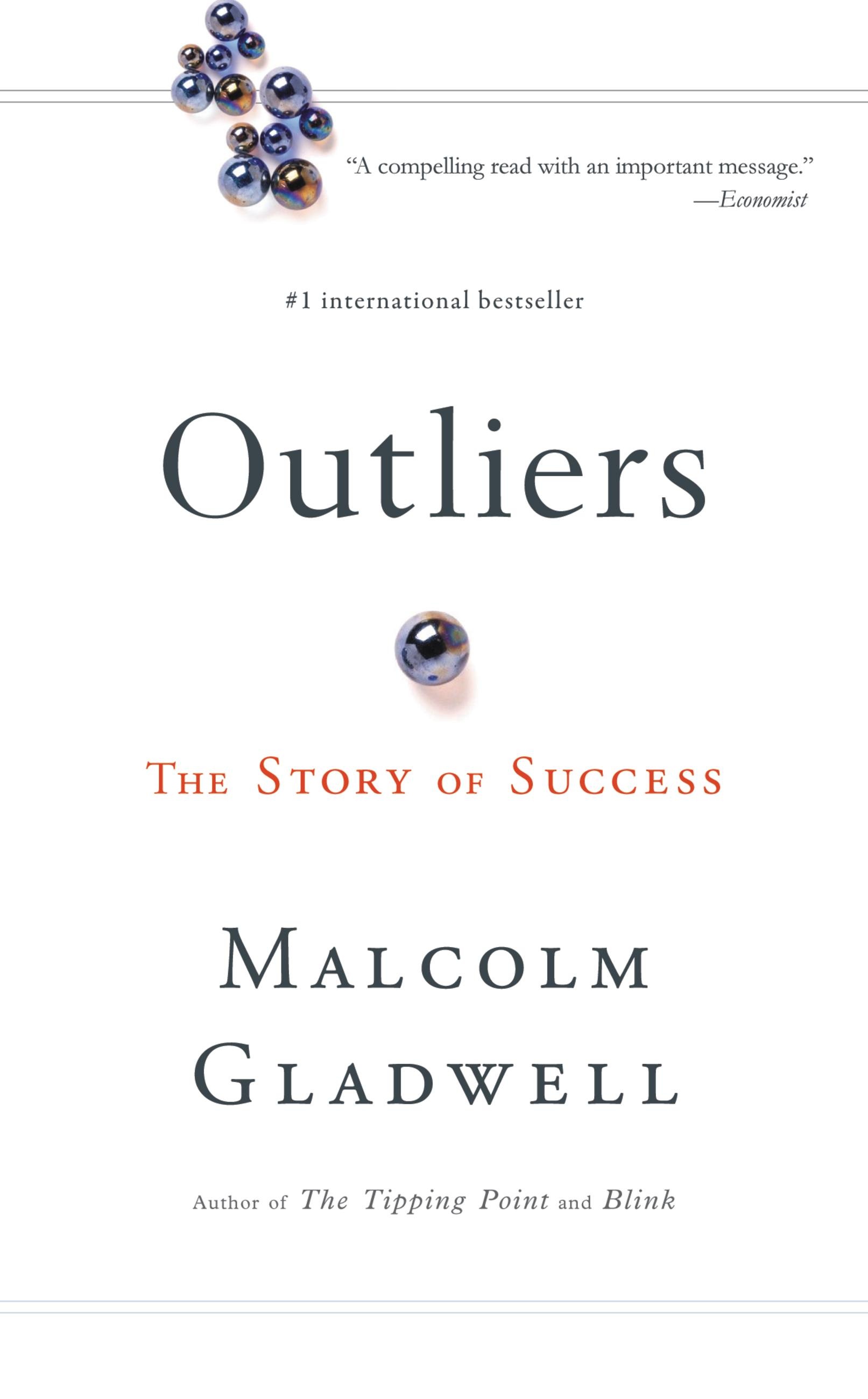
Book Review: Outliers

Copyright © 2019, Steven E. Houchin. All rights reserved.

Outliers, The Story of Success, by Malcolm Gladwell, is a fascinating collection of stories about people and the factors behind their success or failure. Its basic premise is that most people succeed because of a series of circumstances that put them in the right place at the right time with the right support system.

It begins by discussing the people of the remote village of Roseto, PA, and their extraordinary healthiness. They tended to die of old age, rather than ravaged by the diseases that plague the rest of us. When studied, the researchers concluded that the sense of community amongst them - transferred from the Old Country in Italy - created an amazing wellness. No diet, or exercise, or anything else could explain it.

Later, Gladwell discusses the idea that those who succeed have had the opportunity to practice their passion, and poses that 10,000 hours of practice is a threshold at which success can happen. He gives an example of how The Beatles were given an opportunity to play in Hamburg, Germany, and were expected to perform 8 hours per day, versus other bands back home who were lucky to play a 1 hour set. Also, the example of Bill Gates who, as a high school student in the 1970s, had access to a computer at school and the University of Washington where he could write programs for hours each day, when others had no access to computers at all. The result was thousands of hours of practice, all because a fortuitous opportunity came his way.

In another study, the author discusses plane crashes, and a string of Korean Air crashes that seemed inexplicable. The result of the study was that, in cultures where challenging one's superiors is taboo, a co-pilot or other cockpit crew member was unwilling to speak up if the plane captain was making a mistake. This behavior turns out to be the cause of a large percentage of crashes. It is an example of one's culture leading to success or failure. In another example, Gladwell explains rice-growing in East Asia, which requires a 360-day work year, leading to a culture of hard work and persistence (versus other forms of agriculture with spring planting, autumn harvesting, and relative idleness in between). The rice culture has thus led to Asian's education and professional success in modern times.

This book provides fascinating insight into human behavior and how place, culture, and circumstance play a huge role in the outcomes. It is well worth reading and may help any individuals understand how they got where they are, for better or worse.

Tuesday, June 18, 2019

Observations About Literary Contest Submissions, Part III

Copyright © 2019, Steven E. Houchin. All rights reserved.

Another new year, and another new round of literary contests. So, in celebration, I thought I might offer some behind-the-scenes hints for authors who are considering a contest entry.

Some quick background. I have entered the Pacific Northwest Writers' Association's "Literary Contest for Unpublished Work" about five times, was a finalist three times, and won once for a Mystery/Thriller novel. I have also read and critiqued manuscript submissions for this contest four times, which means I was among those who provided scores for entries I read. I've written two other blog postings on this subject, Part I and Part II, so I recommend starting with those.

In this posting, I want to give you an idea what the PNWA contest readers are looking for in your submission, and the process that goes on.

The PNWA contest organizers provide the readers with guidelines, scoring forms, and critique forms to fill out. The critiques focus on key elements of the manuscript, and each of these elements receive a score from 1 to 10. The author receives a copy of the critique, but does not see the scoring. The readers/critiquers are encouraged to be positive and constructive in comments, and not to make critiques sound accusatory, such as "You need to do XYZ ..." I try to include comments that teach a concept, rather than just say something was done badly.

Here are the key elements that are critiqued and scored:
  1. Synopsis - Does it tell the story in a compelling way, and shows a plausible and original story? Does the ending feel satisfying? Does it introduce the main characters well?
  2. Viewpoint - Does each scene have an identifiable character point of view? Does it remain consistent? Does the author intrude into the narrative somehow?
  3. Characterization - Are the characters well developed, believable, distinguishable from one another, and sympathetic in some way? Are their motives clear?
  4. Dialogue - Is dialog necessary and specific to a character? Does it sound realistic? Are dialog tags used properly?
  5. Conflict/Tension/Pacing - Does the storyline keep moving forward, or does the author get mired in character backstory? Does the author show the reader rather than just tell? Do characters struggle, and is the tension raised often?
  6. Hooks/Transitions - Do scenes/chapters end so the reader feels compelled to read on to the next? Are the scene/chapter transitions done smoothly, or do things abruptly jump in time or place with no setup?
  7. Setting/Description/Narrative - Is each scene set up so the reader knows the who, where, and what of the scene? Are descriptions compelling and appropriate? Is the scene and its narration necessary to the story?
  8. Voice - Does the narrator's voice seem right for the work? For example, a Noir genre sounds different than Romance.
  9. Mechanics - Proper sentence structure, punctuation, grammar, spelling, and no typos. Does the manuscript look clean and professional?
  10. Audience Appeal - Will the intended audience be satisfied with the work? Is the writing at the appropriate level for the audience?
Of all these, I have found that many new writers have trouble setting the scene (#7) at the start of a new chapter, and have trouble writing realistic and compelling dialog (#4). Many also make the mistake of filling their Chapter One with character backstory (#5) - often boring - rather than dropping the reader right into the main plot's action.

Once the contest reader evaluates all these elements, he or she gives each one a score, then totals them up. These scores ultimately determine if your manuscript makes the cut as a top-eight finalist in your category. If you do make the finals, your submission is read and evaluated by conference-attending agents and editors, who do the final scoring for winners.

So, if you plan to enter the PNWA contest in 2019 (deadline March 22nd), you might try your own evaluation of these key elements before sending it in.

Sunday, February 3, 2019

Book Review: China Blues

Copyright © 2017, Steven E. Houchin. All rights reserved.

China Blues, by Ki Longfellow, begins by plunging the reader directly into the 1906 San Francisco earthquake, and thus into the lives of the story's main characters. Chapter One jumps ahead to 1923, where we find the same characters (some of whom were children in 1906) now living in the bustling, post-quake city.

Despite the author's stated penchant for noir mystery, I would categorize this book as literary fiction because it immerses the reader so deeply into the characters' private lives and how events change them, and because the descriptive language has such depth and richness. Right from page one, we are treated to images like, "When Los Angeles was a sun-blown pueblo waiting for the movie to begin, San Francisco was the city, a fabulous metropolis by the bay -- straight streets driven reckless up her seven steep hills of yellow sand; tall buildings perched on turbulent slopes like exclamation marks ..." And so it goes throughout the book.

I won't even attempt to describe the plot, but the there are whorehouses, jazzy nightclubs, bootlegger gangs, the mysteries of Chinatown, mobsters, street gangs, ambitious politicians, and the city's wealthy elite. They all meet up and mix up together, spiraling inward to a confrontation right about the time of a Presidential visit to the city. The author does a great job hinting at the trouble to come - whether forbidden love between a rich girl and a Chinese man, a coming war between bootlegger gangs, or political intrigue - the reader keeps turning the page for more.

The book is long - 440 pages paperback - but worth it for the excellent atmospherics, juicy characters and their relationships, historical detail, and great action scenes.

Tuesday, May 29, 2018

Book Review: The Day of Atonement

Copyright © 2017, Steven E. Houchin. All rights reserved.

The Day of Atonement, by David Liss, is set in 1755 Lisbon during the height of the Catholic Church's Inquisition. Englishman Sebastian Foxx has returned after fleeing Lisbon ten years earlier. Back then, he was thirteen year old Sebastião Reposa, a Portuguese boy whose parents were arrested by the Inquisition. A family friend whisks him off to England, where he is placed into the charge of Benjamin Weaver, a "thief-taker" (something like a private detective) whose adventures are detailed in some of Liss's earlier novels. Sebastião is brought up in Weaver's rough-and-tumble world of thieves and cutthroats, where he learns how to handle himself in tough situations.

Sebastião, now Sebastian Foxx, has returned to Lisbon posing as an ambitious English merchant, determined to exact revenge on the Inquisition's top priest, who is to blame for his parents' deaths. But he quickly discovers others who need his help. Old friends threatened by the Inquisition, the girl he loved as a child, and the man who took him to England ten years ago, who is now destitute because of swindle.

As Sebastian maneuvers to help his friends, and makes plans to kill the priest, he slowly discovers he is being manipulated by a web of lies. Friends turn out to be enemies, and visa versa. He must make atonement for wrongs he commits while acting on the lies, and figure out who can and cannot be trusted. At the climax, nature intervenes with a cataclysm that both frustrates and aids in his mission.

As usual, Liss's prose and historical research immerse the reader in the culture and era of 1755 Lisbon, making the story thoroughly believable. Sebastian Foxx is both a failure and hero at various points in his adventure, gullible to misinformation fed him, then cunning and ruthless when necessary to turn the tables. The reader can feel something is amiss, and that Foxx is being set up for a fall, but Liss keeps us guessing.

The book is 363 pages hardback, but is so engrossing it becomes a quick read you can't put down. I've read many other Liss books (see my earlier review of The Coffee Trader), and this one is as compelling as the others. Highly recommended.

Wednesday, August 23, 2017

Observations About Literary Contest Submissions, Part II

Copyright © 2017, Steven E. Houchin. All rights reserved.

Last year I posted an article titled "Observations About Literary Contest Submissions" after being asked to read and score five manuscripts submitted to the Pacific Northwest Writers Association's 2016 Literary Contest. In my posting, I outlined six guidelines and truths about submitting to literary contests, hoping the advice might help new writers who are tempted by a contest. As a two-time finalist and former winner of this contest, I thought maybe I have learned something along the way.

I put my own advice to the test again this year (2017), submitting two entries: a novel and a short story. Both received positive critiques from the first-line readers. And, the novel was chosen as a finalist! I found out in late July that I, unfortunately, did not win this time.

Being a finalist again got me thinking about the guidelines in my earlier posting, and the math involved in contests. In my article, I postulated that simply and precisely following the contest rules, and a cleanly formatted manuscript, would jump you ahead of half the others. Maybe that's an exaggeration, maybe not. But following all my six guidelines may do that and more.

Imagine if you're in a category, like Mystery, with 100 entries. If half of those fail the contest rules and neatness test, your competition drops to 50. Of those, many will fail to write a proper synopsis, maybe 10 of them. Another 20 may fail due to poor writing, such as too much backstory, mundane dialog, no description or scene setting, or a languid pace. So, maybe that 50 now drops to 20 or 25. They are your remaining competition. If the Mystery category has eight finalists, your odds become maybe 1 in 3, versus the original 8 in 100 (about 1 in 12).

Now, my numbers here are pure speculation, but are based on experience having been a reader/scorer for the PNWA contest three times. So, I've seen for myself how often author submissions fall into that bottom 75% where glaring mistakes doom their entries.

So, if you want to greatly increase your odds of being a finalist in a contest, paying attention to the details, and the experience of others, is a good start.

Monday, July 3, 2017

Backstory Blues

Copyright © 2017 Steven E. Houchin. All rights reserved.

One thing that drives me nuts as a reader is the overuse of backstory in a novel, especially when the genre is not literary fiction.

What instigated my grumbling at this time is Alex Kava's A Necessary Evil, which I'd read about one-third through. It introduces a number of characters, some of which are detectives or investigators and such, and some are perpetrators. But what I find, in chapter after chapter, is a story crawling at a snail's pace as the author plunges into the character's miserable past or dysfunctional old relationships. For example, the main character, a female FBI agent, must work with a local female detective on a murder. But in the past, the detective had made a pass at the agent, and now their working relationship is strained. Added to that, the detective once saved the agent's mother from suicide. But also, the agent had once rescued the detective's father from a serial killer. Can you say contrived? But that's just the start of boring backstories whose purpose seems mainly to fill page space and give the impression of conflict.

In my opinion, a murder mystery or suspense thriller is about the story, the plot. It's certainly mandatory to create compelling characters in a genre novel, but that can be done by showing their actions and relationships in the now - often through dialog - not by contrived family backgrounds. I'm not against giving a bit of character history, such as explaining how the protagonist became widowed, or how she inherited wealth from her industrialist father. Just weave it naturally into the story - a paragraph here and there - rather than constantly dumping out several paragraphs of the stuff time after time.

And, of course, the worst backstory sin of all: filling Chapter One with it. Arrrgh! Does anything make a reader gag more that that? Yes, sadly. Finding even more in Chapter Two.

I was having lunch with a few writer friends recently, and one author described a novel of his where the plot seemed to rely on a series of implausible character and family relationships that would do any TV soap opera proud. I cringed at the inevitable pages of backstory it must contain to untangle all the mess. And, in the end, would it have any discernable plot?

So, I did not bother finishing the last two-thirds of A Necessary Evil. I found myself skipping over paragraphs whenever a hint of dreaded backstory crept in. It just isn't worth it, wading though all that to try to get back to the actual story.

Many good articles exist online that discuss the evils of backstory done wrong and how to do it better. So I won't attempt to expound on it here. Suffice to say, it's a disease that plagues aspiring writers and experienced, published authors alike.

And please ... don't get me started on flashbacks. But, that's for another time.