Monday, June 20, 2011

Move the Story Forward

Copyright © 2011, Steven E. Houchin. All rights reserved.

Keep the reader turning the page. I always try to keep that in mind when I write a short story or a chapter in a novel. In a critique group recently, I was reminded of that when one of my group-mates observed that my chapter ended by wrapping up a mystery, but didn’t provide any teaser to propel the reader on to the next chapter where, presumably, things will begin to unravel (not for the author, of course, but for the characters).

“Why should I turn the page?” she asked.

Ouch! She was right. Mystery and conflict remain for the reader to discover, but I failed to show that. When I read or hear stories from other aspiring writers in my little world, I often think the same thing. Here are some common deficiencies:
  • Description - The story is crammed with flowing, minute descriptions of people, their movements, things, the weather, sounds. Description is great if it is done right, if it sparks your mind’s eye (see my blog posting Descriptive Dalliances). But, is the story lost in all the picture-painting? After 10 pages of prose, will the reader say, “All those words just to pick up the bloody knife in his hand?”
  • Pleasantness - The story’s characters go on and on in pleasant conversation about what they plan to do later or what they just finished doing or what they wish they could do. At the end of the chapter, they might walk out the door to actually go do something. But, the chapter is stuck in neutral up to that point. Maybe somebody should cry, or yell, or argue, or faint along the way. Hints about coming trouble can trickle out. Dinner can burn and fill the house with smoke. Aunt Agatha can reveal something shocking. These incidents can be used to set up future tension, or flesh out the characters’ relationships, and to cause the reader to wonder what it portends in coming pages.
  • Fizzled ending - The chapter comes to an end, but it feels like nothing interesting will happen next. A couple sits on the picnic blanket gazing out over the lake holding hands. Okay ... so? What if instead, they hear a strange rattling sound, but dismiss it? The reader might think, “Oooh. A rattlesnake?” This is basically the art of the cliffhanger - adding it at the end of each chapter or scene to spur the reader to stay tuned.
  • Preaching - One of the biggest turn-offs in a novel is when the author fills the pages with some agenda they feel strongly about: religion, environment, politics, conspiracies. These subjects don’t need to be eliminated altogether, just included in a subtle way that doesn’t overwhelm the story or bore the reader.
  • Blandness - This may seem obvious, but it happens a lot for aspiring writers. Characters engage in mundane dialog, or speak in ways that aren’t realistic. The narrator tells us facts and figures that may be nice for a scholarly article, but don’t hold interest in a novel where the reader wants action or romance or humor. Or, the pages may be filled with continuous dialog with no scene-setting, gestures, pauses, description, or narration.
You can probably think of several more substandard writing aspects than this. The bottom line is: will the reader feel compelled to turn page after page? If so, then you’ve done something right.

Friday, June 17, 2011

Book Review: Bel Canto

Copyright © 2011, Steven E. Houchin. All rights reserved.

Ann Patchett's award-winning novel Bel Canto takes place in a Latin American nation, where attendees at a birthday party in the Vice President's mansion find themselves taken hostage by a rebel force.  The rebels plan to kidnap the President.  But he canceled his attendance at the last minute to stay home and watch his favorite TV soap opera.  The rebels aren't sure what to do, so they hold onto the most prominent men and the one woman at the party who matters: opera singer Roxane Coss, who was the party's entertainment.  Weeks go by.  Negotiations are stalled.  The rebels' strict regimen toward the hostages slackens, and life inside the mansion becomes a small, insular world of its own as hostages and some of the younger rebels bond.  Roxane Coss, deciding she must sing to keep her voice strong, practices her opera daily - delighting rebels and hostages alike.  Life outside the compound is nearly forgotten.  The standoff will never end, they think, so this is all there is.

The entire story takes place in the mansion.  As the story goes on, we see numerous characters contribute their own skills to the smooth operation of their new world.  A pianist.  A cook.  A translator.  The Vice President, who essentially becomes the housekeeper.  Many of the young rebels, who have lived only in the backwoods, learn about society and luxury they've never imagined before, such as watching TV for the first time.   One character, a multilingual Japanese translator named Gen, falls in love with Carmen, one of the young rebels.

Patchett does a masterful job of developing each character without dumping loads of backstory on the reader.  The reader feels sympathy for a General with the disease shingles, which causes an ugly, painful rash on his face. Or Cesar, who learns he can sing opera beautifully.  Or Carmen, who helps Roxane Coss arrange an amorous tryst with a Japanese businessman.  The reader begins to live vicariously in the little false world of the hostages, which is bound to come to a tragic end.

Patchett's language is lyrical, the descriptions rich and humorous at times.  She does not stick to any one character's point-of-view, but rather lets it flow from one person to the next, paragraph by paragraph - and makes it work.

If you long for a novel that explores complex situational character relationships, Bel Canto is worth your time.

Friday, June 3, 2011

It’s Real Life, For Once

Copyright © 2011, Steven E. Houchin. All rights reserved.

I just sent off a short story for Writers Digest’s “Your Story” Contest #34. The rules specified to start off with the line of dialog, “You won’t believe what came in the mail today.”

My novels and short stories are based upon anything but my real life. After all, I usually don’t shoot at people, or steal wartime secrets, or blackmail my parrot’s previous owner, or time warp back to 1889 to chase down an arsonist, or wear clown makeup to bed. Although, come to think of it, the clown makeup sounds intriguing.

But, for the Your Story contest, the opening line immediately brought to mind my elderly aunt who passed away a few years ago. The postman’s arrival seemed the big highlight of her day, judging by the attention she gave to all the junk mail that poured in. Scams and gimmickry abounded in nearly every envelope - all clearly aimed at taking advantage of the elderly, who are often all too susceptible to emotional pleas. Added to that, her world was rocked when mail delivery was changed to 5:00 pm. Horror of horrors. What would she have to talk about if not the mail? What would she do with herself all day? The change to her routine drove her to distraction until, mercifully, the postal service moved her delivery back to late morning.

So, my beloved aunt provided the exact subject matter I needed for my short story. The precious pieces of mail, the scams she fell prey to, the junk she ordered, the altered delivery time. No guns or clowns or parrots or arson. Just real life put down on digital paper with a bit of author’s poetic license to weave it all together. Whodda thunk?

Tuesday, May 10, 2011

Literary Contest Update

Copyright © 2011, Steven E. Houchin. All rights reserved.

I've just updated my author website with the latest fiction contests I have researched for the rest of May 2011 and into June and July.  Check back often to see any additions.


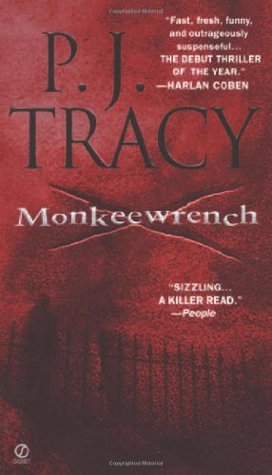
Book Review: Monkeewrench

Copyright © 2011, Steven E. Houchin. All rights reserved.

Monkeewrench is a Minneapolis software company developing a macabre game: Serial Killer Detective. When real life corpses begin to appear exactly as depicted in the game's gruesome scenarios, Detective Leo Magozzi suspects one of Monkeewrench's five employees, who all carry guns and a puzzling past: they don't seem to have one.

At the same time, over in Kingsford County, Wisconsin, Sheriff Michael Halloran struggles to solve the murder of a couple whose bodies are found in the pews of the local Catholic Church. When he and a deputy go to search their house, a rigged shotgun on the back door kills the deputy. The dead couple aren't who they seem, either.

Author P. J. Tracy (i.e. mother and daughter writing duo Patricia and Traci Lambrecht), swap back and forth between these two unconnected murder storylines until they cleverly come together when Magozzi and Halloran both follow the clues to a Catholic School in New York. The Mother Superior there casually comments to Halloran's deputy that "in all the years she's been at the school they have never once gotten a call from a law enforcement agency before, and wasn't it peculiar that this morning she had two." The two cases spiral together after that.

The novel's characters display distinct attributes and attitudes. The detectives are suitably jaded, and the Monkeewrench people are dubious of anything the police might do. The author keeps you guessing as to the culprit, leading you down multiple paths of suspicion, creeping inexorably to the big climax. Along the way, the ride-along with Magozzi and Halloran is enjoyable.

Unfortunately, the ending breaks a cardinal rule (in my opinion) of a whodunit mystery: the murderer is a minor character who is hardly seen onstage throughout the novel. Thus, the ending feels too contrived, like a Perry Mason episode where the little-seen gardener suddenly confesses on the witness stand, having some heretofore-unknown motive. Regardless, Monkeewrench is well written; a great read and worth the time you spend with it.

Thursday, May 5, 2011

Self-Publishing Workshop Post Mortem

Copyright © 2011, Steven E. Houchin. All rights reserved.

Recently, I attended a self-publishing workshop at a local bookstore. The presenters were Bob Lanphear, a book designer, and Lorrie Harrison, an editing and publishing consultant.


Editing Process

Lorrie began by discussing the editing process your book should go through before self-publishing. 1) Self-proofreading to create a clean manuscript, 2) Peer review (critique) to make sure the story is viable, 3) Professional line editing.

She stressed that writers need to belong to a “tribe” of other writers and supporters, rather than write in isolation. One online proofreading tool that was mentioned is ErrNET, which is purported to take as input your PDF-format manuscript and will spit out errors it finds.

Layout and Graphic Design

Bob discussed the options for self-publishing. You can use Internet print-on-demand (POD) options, such as Amazon’s Create Space or Lulu. You can try do-it-yourself layout and design with software such as Adobe Illustrator, Microsoft Publisher, or GIMP. There are self-publishing companies that print as many copies as you want to pay for with little editorial input. Or, you can partner with a local creative team (which is what Bob and Lorrie are).

A number of time-consuming steps are taken during the self-publishing timeline: assembling graphic input, cover design, interior page design, page layout, proofing and prep for printing, actual print production, development of an eBook, and book promotion.

A book cover isn’t about what the author likes, but what will attract the audience. He often has to challenge the author’s preconceptions about design and recommends he/she browse the bookstores to see the designs of similar works. People do judge by the cover. And, depending on the type of book, the page design can influence the reader’s experience and appeal to emotions. Good cover art can carry over to other promotional materials, such as the book’s web site, posters, blurbs, bookmarks, audio CD.

He listed a number of reasons why a book can fail:
  1. The book is unnecessary, already been done.
  2. Bad cover design.
  3. A lame title.
  4. No professional editing/proofreading.
  5. Thinking too small—not trying for large sales, give away too few review copies.
  6. Old fashioned promotion.
  7. Trying to do it all yourself rather than hire interns or professionals.
Marketing/Promotion

Lorrie talked about marketing your book. Ninety percent of a book’s success is author promotion. Two key things you must know before selling your book: 1) Why am I writing this book? 2) Who is my audience?

If you plan to use self-publishing to snag a traditional publisher, they will evaluate your book’s velocity—how many copies sold in 2 or 3 months. So, be prepared to create demand as soon as your book is published.

If your dream is to have your book on the shelf in Barnes and Noble or Borders, you will be working through a distributor. You will get paid when the distributor sells copies of your book to the retailer. But, any unsold copies can be returned after 12 months, and you have to return any money received for them.

Lorrie shared ideas for better ways to market the book:
  • Your website should allow purchases. This way, you keep 100% of the profit. Make sure to buy the Internet domain name for your book’s title. A web site also establishes your brand as an author.
  • Look at traditional, non-book retail catalogs who might be willing to carry your book (such as clothing retailers for a book about fashion). Knowing your audience helps identify these retailers.
  • Contact independent bookstore managers to arrange readings, signings and to provide promotional materials like flyers.
  • Give away lots of free copies, such as leaving in waiting rooms (doctor, dentist), or where people congregate. Same for promotional items like customized bookmarks.
  • Make sure your marketing plan is organized in advance, before the book hits the streets.
Some books about marketing and promotion Lorrie recommends:
  • “Dan Poynter’s Self-Publishing Manual: How to Write, Print and Sell Your Own Book” - Poynter.
  • “1001 Ways to Market Your Books” - Kremer.
  • “Jump Start Your Book Sales: A Money-Making Guide for Authors, Independent Publishers and Small Presses” - Ross.
  • “Guerrilla Marketing for Writers : 100 Weapons to Help You Sell Your Work” - Levinson, Frishman, Larsen.

Tuesday, April 26, 2011

Spark Your Imagination With Writing Prompts

Copyright © 2011, Steven E. Houchin. All rights reserved.

Short stories, as with all fiction, require inspiration. Sometimes, real life can supply all you need. Scenes from movies or books can spark ideas. Or, you may have a fertile, twisted imagination.
For me, I’ve found that writing prompts are a great starting point. A writing prompt is a one or two sentence scenario from which a writer can construct a scene. Some are purely exercises, such as describing some object in your bedroom. Others place a character in a frightening or offbeat situation.

Here is one interesting prompt:
You have been captured by cannibals. How do you try to convince them not to eat you? If that fails how do you attempt to get away?
Here is one that is more of an exercise:
Write a scene where shadows or lighting create a mood.
Two writing prompts that particularly intrigued me turned into great short stories that received laughs and even applause at a writers workshop I regularly attend. I maintain a text file on my computer system to save interesting prompts as I come across them. I also jot down my own ideas, some of which are bare-bones notations, like:
An overgrown cemetery.
Or ...
A pet snake gets loose.
These are little things that flash into my mind or appear in a movie, and seem at the moment to have potential.

An excellent site to find writing prompts is Writer’s Digest. They add to them regularly and keep a long list of the older ones. So, if your imagination needs a jump start, take a look at it, or use your favorite search engine to find other writing prompts online.